




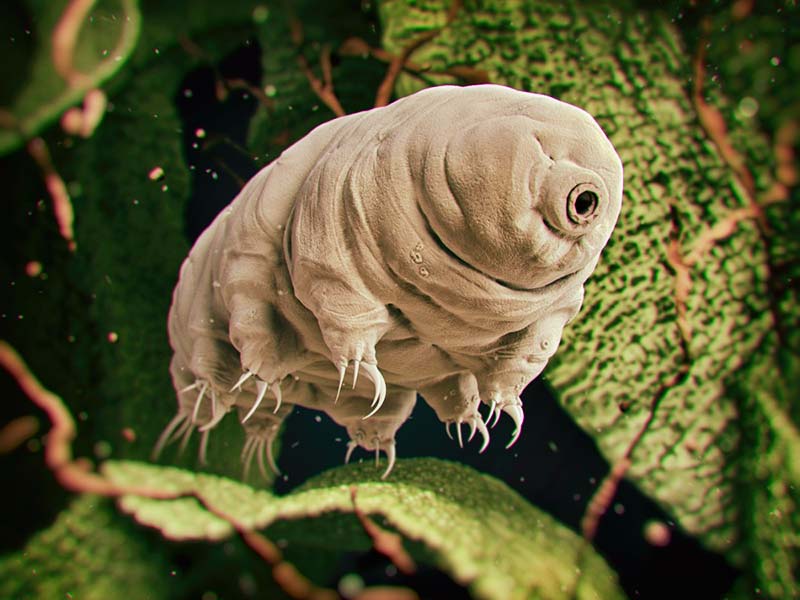
The tardigrade, often called the water bear, is one of the most extraordinary organisms ever studied. It is known for its incredible ability to survive extreme environments, including being frozen completely solid in ice. This makes the tardigrade one of the toughest animals on Earth and a constant source of fascination for scientists, nature enthusiasts, and researchers studying the limits of life.
This SEO content explores what makes tardigrades able to survive freezing, how they enter a suspended state, and why this tiny creature is considered a symbol of resilience in the natural world.
What Is a Tardigrade
Tardigrades are microscopic animals usually measuring between 0.3 and 0.5 millimeters. Despite their small size, their bodies are highly complex. They have eight legs, a segmented body, and a mouth part used for feeding on plant cells, algae, or bacteria. These creatures live in environments rich in moisture such as moss, soil, leaf litter, and freshwater habitats.
Their ability to survive under extreme conditions makes them a major subject of study in biology, astrobiology, and environmental science. Scientists look at tardigrades not just as animals, but as living clues to how life might survive on other planets.
How Tardigrades Freeze and Survive
The most impressive ability of tardigrades is their capability to endure being frozen completely. When temperatures drop to extreme levels, tardigrades do not die. Instead, they enter a state called cryptobiosis, a form of suspended animation where almost all biological processes stop.
During this state, tardigrades lose nearly all the water in their bodies and curl into a dry, compact form known as a tun. In this form, their metabolism decreases to nearly zero. Ice cannot harm the cells because there is not enough water left inside the body to form damaging ice crystals.
Once the temperature rises and moisture returns, the tardigrade rehydrates and comes back to life, resuming normal activities as if nothing happened.
Survival in Extreme Cold Based on Scientific Studies
Studies have shown that tardigrades can survive freezing at temperatures far below what most animals can tolerate. Some experiments demonstrate that tardigrades can live after being exposed to temperatures as low as minus 200 degrees Celsius. This is colder than the surface of Mars.
Their survival is supported by unique proteins that protect their cells. These proteins stabilize cell structures and prevent damage during freezing. Because of these adaptations, tardigrades can endure conditions that would instantly kill most other organisms.
Why the Tardigrade’s Freeze Ability Matters
The freezing survival of tardigrades has important implications for science and technology. Their biological adaptations could inspire better methods of preserving cells, organs, or even human tissue. The ability to enter suspended animation may also help researchers explore possibilities for long duration space travel.
Astrobiologists are particularly interested because tardigrades demonstrate that life can survive deep freezes and then revive. This increases the possibility that life on other planets could exist even in extreme and frozen environments.
Where Tardigrades Are Found Today
Although tardigrades are famous for their extreme abilities, they are not rare. They can be found almost everywhere on Earth. They live in forests, mountains, oceans, polar regions, and even urban environments. If you look at a patch of moss under a microscope, there is a good chance you will see a tardigrade crawling between the leaf cells.
This wide distribution shows that tardigrades are not only tough but also remarkably adaptable. They thrive in ordinary environments just as easily as in extreme ones.
Why the Tardigrade Continues to Fascinate the World
Tardigrades represent resilience in its purest form. Their ability to freeze and revive pushes the limits of what we understand about life. Scientists continue studying them to unlock secrets of survival, biology, and even the future of human exploration.
For the general public, tardigrades are a reminder that even the smallest creatures can be powerful, mysterious, and full of surprises. Their body may be tiny, but their abilities make them giants in the world of science.
