




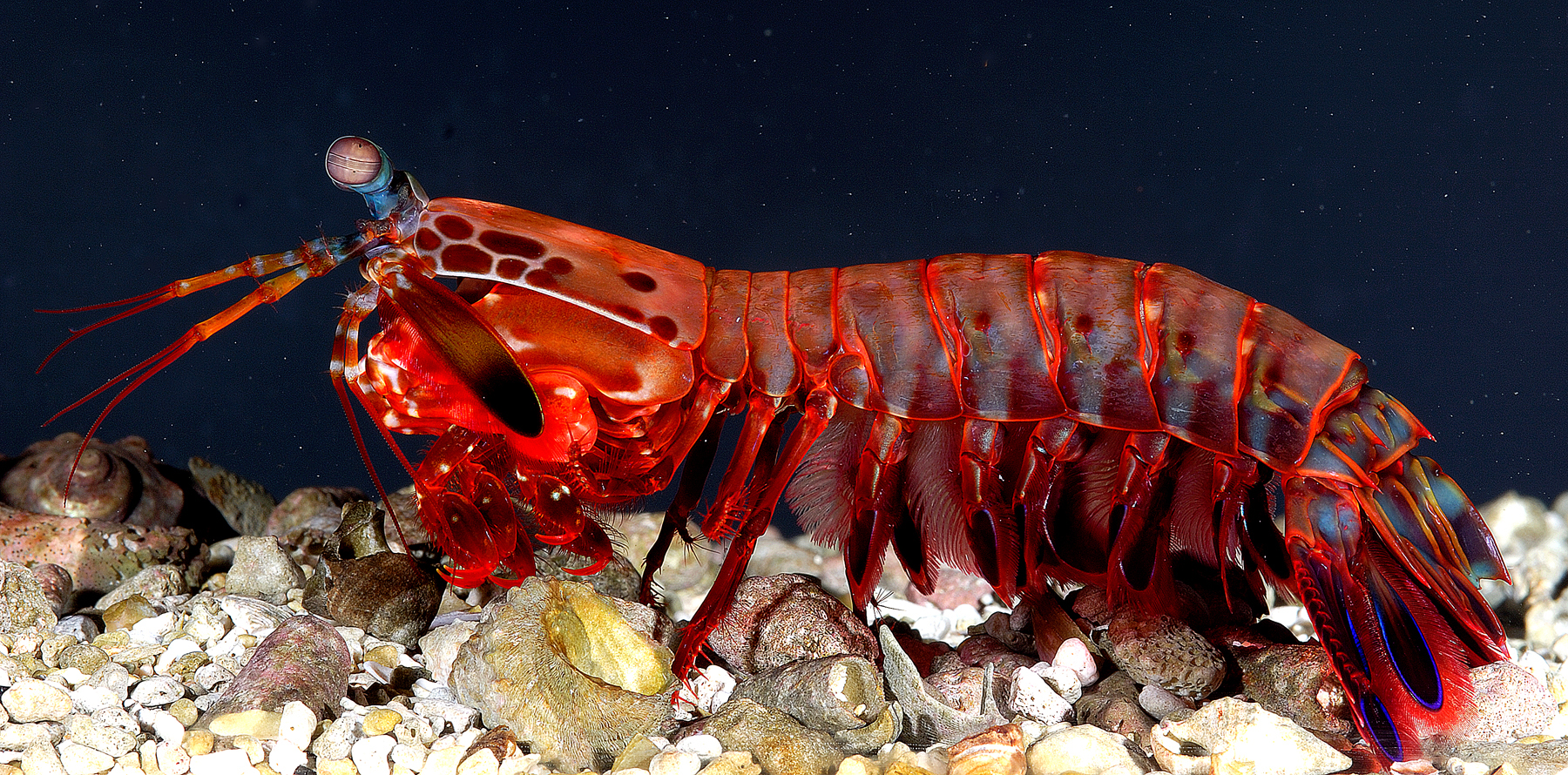
The ocean is full of creatures that challenge the way humans understand biology, and the mantis shrimp is one of the most extraordinary examples. Often described as an animal with eyes on its knees, the mantis shrimp has visual organs mounted on flexible stalks that move independently from its body. These eyes are positioned close to where its legs connect to its body, creating the impression that the shrimp sees from its knees. This unusual anatomy is only one part of what makes the mantis shrimp one of the most fascinating animals in the sea.
What Is a Mantis Shrimp
The mantis shrimp is a marine crustacean that lives in warm tropical and subtropical waters around the world. Despite its name, it is not a true shrimp and is more closely related to crabs and lobsters. Mantis shrimp usually live in burrows within coral reefs or sandy ocean floors, where they wait for prey or defend their territory.
There are hundreds of species of mantis shrimp, ranging in size from just a few centimeters to more than thirty centimeters long. Their bodies are brightly colored, often featuring shades of green, red, blue and orange. These colors are not just decorative but play a role in communication and camouflage.
Why It Looks Like the Eyes Are on the Knees
The phrase eyes on its knees comes from the unusual placement of the mantis shrimp’s eyes. Each eye sits on a movable stalk near the front of the body, close to the joints of its front limbs. When the shrimp is resting or moving, the eyes can appear to be positioned where knees would be if the animal were standing upright.
These eyes can rotate and move independently, allowing the mantis shrimp to scan its surroundings without moving its body. This ability is especially useful when hiding in a burrow, as the shrimp can watch for predators or prey while remaining mostly concealed.
The Most Complex Eyes in the Animal Kingdom
Mantis shrimp eyes are considered among the most complex visual systems known to science. Each eye contains multiple layers of photoreceptor cells that allow the shrimp to detect a wide range of colors. Some species can see ultraviolet and polarized light, which humans cannot perceive.
Instead of processing color in the brain like humans do, mantis shrimp process color directly in their eyes. This allows them to recognize colors very quickly, which is useful in fast paced underwater environments. Their vision helps them identify prey, rivals and potential mates with incredible speed and accuracy.
How Mantis Shrimp Use Their Vision
The mantis shrimp relies heavily on its advanced eyesight for survival. It uses visual signals to communicate with other mantis shrimp, displaying patterns and colors to show aggression or readiness to mate. These visual cues are essential in maintaining territory and avoiding unnecessary fights.
Their vision also plays a role in hunting. Mantis shrimp are known for their powerful strikes, using specialized front limbs to smash or spear prey. Precise vision allows them to judge distance and timing perfectly. In some species, the strike is so fast that it creates a small shockwave in the water, stunning or killing prey instantly.
Life in Coral Reefs and Burrows
Mantis shrimp prefer environments where they can dig or occupy existing burrows. Coral reefs, sandy bottoms and rocky crevices provide ideal habitats. From their burrows, they watch the surrounding area using their independently moving eyes.
They are highly territorial animals and will aggressively defend their homes. Their combination of sharp vision and powerful limbs makes them formidable opponents, even to animals larger than themselves.
Scientific Interest and Research
Scientists study mantis shrimp eyes to better understand vision and light detection. The unique way these animals process color has inspired research in optics and imaging technology. Some studies explore how mantis shrimp vision could improve satellite imaging, medical scanners and underwater cameras.
The placement and structure of their eyes also provide insight into how vision can evolve differently depending on environmental needs. The mantis shrimp proves that there is no single perfect design for eyesight in nature.
A True Marvel of the Ocean
The mantis shrimp is far more than an animal with eyes on its knees. It is a masterpiece of evolution that combines advanced vision, powerful movement and striking appearance. Its unusual anatomy challenges traditional ideas about how animals see the world.
By studying creatures like the mantis shrimp, humans gain a deeper appreciation for the diversity and creativity of life beneath the ocean’s surface. This small but mighty predator reminds us that nature often produces solutions far more complex and impressive than we can imagine.
