




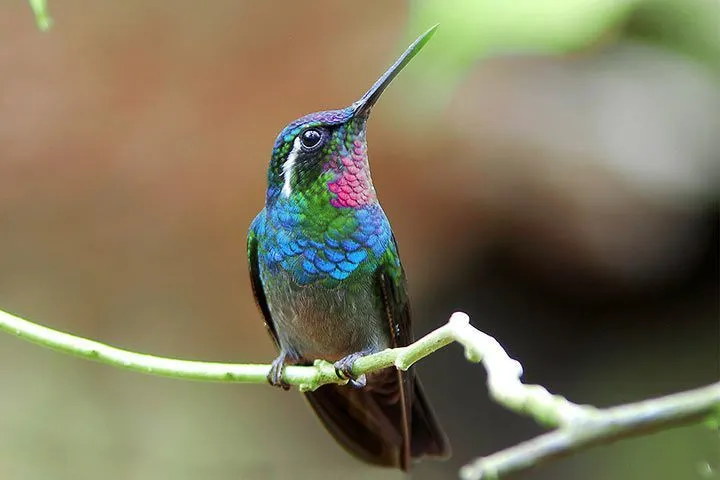
Hummingbirds are among the smallest and most fascinating birds in the world. Known for their rapid wing movement and ability to hover in midair, these tiny birds also possess a remarkable biological feature. The hummingbird has a needle like tongue that allows it to feed efficiently on flower nectar. This specialized tongue plays a crucial role in the bird’s survival and makes hummingbirds one of nature’s most precise feeders.
What Is a Hummingbird
Hummingbirds are small birds found mainly in the Americas, ranging from Alaska to the southern tip of South America. There are more than three hundred species of hummingbirds, each adapted to different environments. Despite their small size, they are highly active and require large amounts of energy to support their fast metabolism and constant movement.
Their bodies are lightweight, their wings are narrow and powerful, and their beaks are long and slender. These physical traits work together to help hummingbirds access nectar deep inside flowers.
The Structure of the Needle Like Tongue
The hummingbird’s tongue is long, thin and split at the tip. It can extend far beyond the bird’s beak and resembles a tiny needle. For many years, scientists believed hummingbirds used their tongues like straws to suck nectar. However, research has shown that the tongue works more like a pair of elastic grooves.
When the tongue enters a flower, the split tips open and flatten. As the tongue retracts, the tips curl inward, trapping nectar inside. This rapid motion allows hummingbirds to collect nectar efficiently in a fraction of a second. The tongue can move in and out of the flower up to twenty times per second.
Why the Tongue Is So Important
Nectar is the primary energy source for hummingbirds. Because they burn calories extremely fast, they must feed frequently throughout the day. The needle like tongue allows them to extract nectar quickly without wasting time or energy.
This feeding method also helps hummingbirds avoid predators. By spending only a short time at each flower, they reduce the risk of being caught while feeding. Their tongue design is a perfect example of how evolution shapes animals to survive in demanding environments.
Feeding Behavior and Flower Relationships
Hummingbirds play an important role in pollination. As they insert their beaks and tongues into flowers, pollen sticks to their feathers and beaks. When they move to the next flower, they transfer pollen and help plants reproduce.
Many flowers have evolved shapes and colors specifically to attract hummingbirds. Bright red and orange flowers with deep tubular shapes are especially appealing to them. This relationship benefits both the bird and the plant, creating a balanced ecological partnership.
Life Powered by Extreme Energy
A hummingbird’s heart can beat more than one thousand times per minute during flight. To support this energy demand, they rely heavily on nectar sugars. In addition to nectar, hummingbirds also eat small insects and spiders to obtain protein and nutrients.
At night or during cold weather, some hummingbirds enter a state called torpor. Their body temperature and heart rate drop, allowing them to conserve energy. This adaptation helps them survive when food is scarce.
Habitat and Distribution
Hummingbirds live in a wide range of habitats including forests, mountains, deserts and gardens. They are especially common in tropical regions where flowering plants are abundant year round. Some species migrate long distances, traveling thousands of kilometers between breeding and feeding areas.
Despite their small size, hummingbirds are highly adaptable. Urban gardens with flowering plants and feeders have become important food sources for many species.
Scientific Interest in Hummingbird Tongues
Scientists study hummingbird tongues to better understand fluid dynamics and biomechanics. The unique way the tongue collects nectar has inspired research in micro engineering and medical tools. By learning from the hummingbird, researchers explore new ways to move liquids efficiently on a very small scale.
The hummingbird demonstrates how specialized anatomy can solve complex challenges. Its needle like tongue is a masterpiece of natural engineering.
A Tiny Bird with a Powerful Design
The hummingbird may be small, but its biological features are incredibly advanced. The needle like tongue allows it to survive on nectar, support extreme energy demands and contribute to pollination across ecosystems. This tiny bird is a reminder that even the smallest animals can possess some of the most impressive adaptations in nature.
