




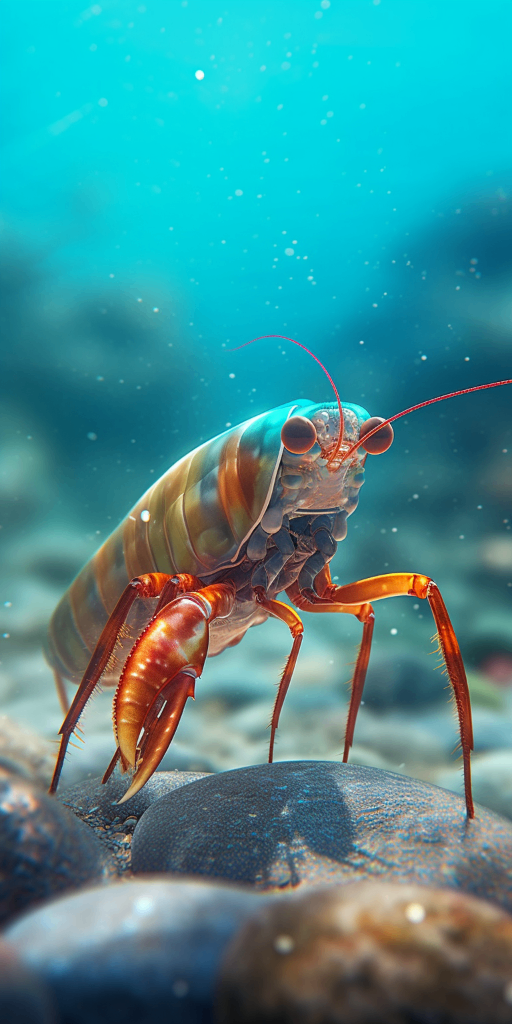
The pistol shrimp may be small, but it is one of the most fascinating animals in the ocean. Known for its powerful snapping claw, this tiny crustacean also possesses an extraordinary visual ability. Thanks to the unique structure of its eyes, the pistol shrimp has near 360 degree vision, allowing it to detect movement and threats from almost every direction at once. This rare adaptation makes it a master of awareness in the underwater world.
What Is a Pistol Shrimp
Pistol shrimp, also known as snapping shrimp, belong to the family Alpheidae. They live in warm and temperate oceans around the world, often hiding in sandy burrows, coral reefs, or rocky seabeds. Despite usually being only a few centimeters long, pistol shrimp are famous for producing one of the loudest sounds in the ocean relative to their size.
Their most recognizable feature is one oversized claw that can snap shut with incredible speed, creating a shockwave powerful enough to stun or kill small prey.
How Pistol Shrimp Achieve Near 360 Degree Vision
The pistol shrimp’s eyes are positioned on stalks that can move independently. Each eye provides a wide field of view, and together they allow the shrimp to monitor almost its entire surroundings. This gives the pistol shrimp near 360 degree vision, meaning very little happens around it without being noticed.
Unlike human vision, which relies heavily on detail, pistol shrimp vision is more focused on detecting motion and changes in light. This makes them highly effective at spotting predators, rivals, or approaching prey in their complex reef environments.
Why 360 Degree Vision Is Important
Living close to the seafloor exposes pistol shrimp to constant danger. Fish, octopuses, and other predators can attack from above, behind, or from within narrow crevices. Near 360 degree vision gives the shrimp a crucial survival advantage by allowing it to react instantly.
This wide field of view also helps during hunting. The shrimp can detect prey movement while remaining safely hidden inside its burrow, ready to strike with its snapping claw.
The Famous Snapping Claw
While its vision is impressive, the pistol shrimp is best known for its powerful claw. When snapped shut, the claw creates a high speed jet of water that forms a cavitation bubble. When this bubble collapses, it produces a shockwave, a loud popping sound, and a brief flash of light caused by extreme heat.
This snap is used to stun prey, defend territory, and communicate with other shrimp. Combined with near 360 degree vision, the snapping claw makes the pistol shrimp a surprisingly dominant presence in its habitat.
Habitat and Symbiotic Relationships
Pistol shrimp are commonly found in coral reefs, sandy bottoms, and shallow coastal waters. Some species form symbiotic relationships with goby fish. In this partnership, the shrimp digs and maintains a burrow while the goby acts as a lookout.
The goby relies on its eyesight to warn the shrimp of danger, but even without this partner, the shrimp’s own wide vision helps it stay alert and responsive.
Diet and Feeding Behavior
Pistol shrimp feed on small fish, worms, plankton, and crustaceans. They use their snapping claw to immobilize prey before pulling it into their burrow to eat. Their excellent vision helps them time their attack precisely, even in low light conditions.
This hunting strategy allows them to conserve energy while remaining effective predators.
Scientific Interest in Pistol Shrimp Vision
Scientists study pistol shrimp vision to better understand how animals process visual information in challenging environments. The shrimp’s eyes are adapted for detecting contrast and motion rather than fine detail, offering insights into alternative visual systems beyond those seen in humans.
Research into their sensory abilities also inspires technological ideas, including motion detection systems and underwater monitoring tools.
Why the Pistol Shrimp Is So Remarkable
The combination of near 360 degree vision and one of the most powerful biological weapons in the ocean makes the pistol shrimp truly unique. Few animals match this balance of awareness and offensive capability, especially at such a small size.
Despite being easy to overlook, the pistol shrimp is a perfect example of how evolution can produce highly specialized and effective survival strategies.
The pistol shrimp proves that size does not limit power or sophistication in the animal kingdom. With near 360 degree vision and an explosive snapping claw, this tiny crustacean dominates its environment through awareness, precision, and speed. The pistol shrimp remains one of the ocean’s most impressive examples of how extraordinary adaptations can arise in even the smallest creatures.
