


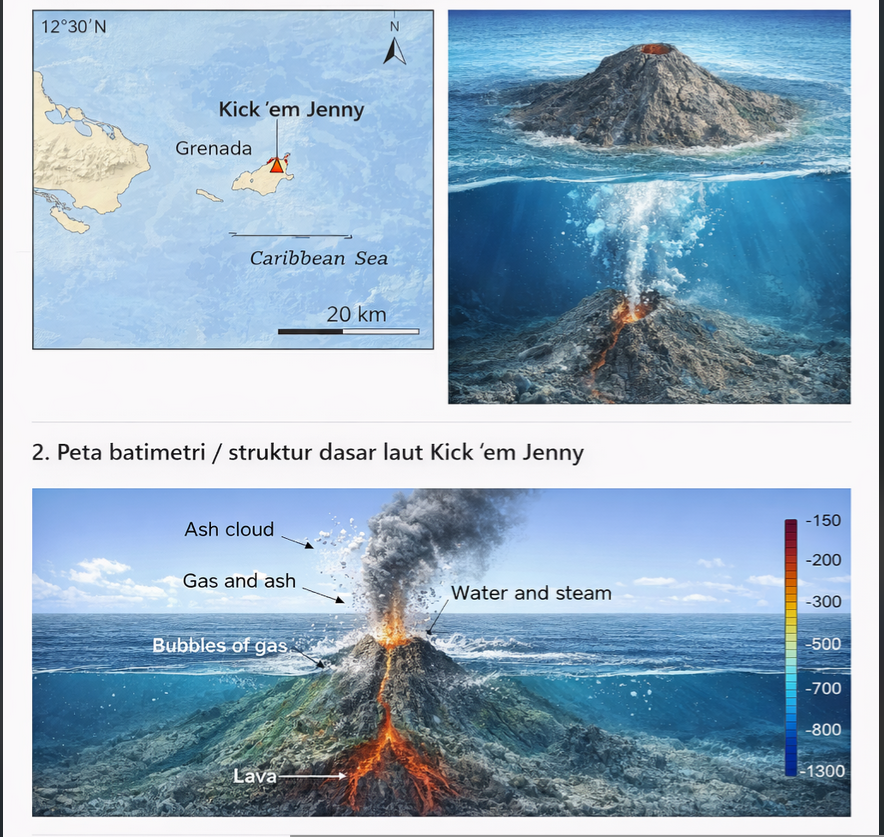
Hidden beneath the surface of the Caribbean Sea lies one of the most closely monitored undersea volcanoes in the world: Kick ’em Jenny. Located just north of Grenada, this submerged volcano remains highly active and poses potential risks to nearby islands. Although invisible to the naked eye, Kick ’em Jenny has the power to reshape the seafloor and, under certain conditions, trigger small tsunamis.
What Is Kick ’em Jenny?
Kick ’em Jenny is an active submarine volcano situated approximately eight kilometers north of the island of Grenada in the eastern Caribbean. Unlike towering land volcanoes, Kick ’em Jenny lies beneath the ocean surface, with its summit located just a few hundred meters below sea level.
Discovered in 1939 following a powerful eruption that generated noticeable waves along Grenada’s coast, Kick ’em Jenny quickly became recognized as a serious geological feature. Since then, it has experienced numerous eruptions, making it one of the most active undersea volcanoes in the Caribbean region.
Geological Setting and Formation
Kick ’em Jenny is part of the Lesser Antilles volcanic arc, a chain of volcanoes formed by the subduction of the Atlantic Plate beneath the Caribbean Plate. This tectonic process generates magma that rises through the Earth’s crust, feeding both underwater and land-based volcanoes across the region.
Over time, repeated eruptions have built up the volcanic cone of Kick ’em Jenny on the ocean floor. Although still submerged, the volcano continues to grow, and scientists carefully monitor whether future eruptions could bring it closer to the surface.
Eruptions and Volcanic Activity
Since its discovery, Kick ’em Jenny has erupted more than a dozen times, with recorded activity occurring in 1965, 1974, 1988, 2001, and several other years. Most eruptions are relatively small and occur entirely underwater, releasing gas, ash, and volcanic material into the surrounding sea.
Despite their size, underwater eruptions can be dangerous. Sudden explosions may displace large volumes of water, potentially generating waves that affect nearby coastlines. Historical records suggest that some past eruptions of Kick ’em Jenny produced small tsunamis that were felt in northern Grenada.
Tsunami Risk and Coastal Impact
One of the main concerns surrounding Kick ’em Jenny is its potential to trigger tsunamis. While large, destructive tsunamis are considered unlikely, smaller waves remain a real possibility. These waves could pose risks to coastal communities, boats, and infrastructure near Grenada and neighboring islands.
In addition to eruptions, volcanic landslides or collapses of the underwater cone could also displace water. For this reason, maritime exclusion zones are enforced around the volcano to protect fishermen and vessels from sudden hazards.
Monitoring and Scientific Research
Kick ’em Jenny is continuously monitored by the University of the West Indies Seismic Research Centre. Scientists use seismic sensors, underwater instruments, and satellite data to detect signs of increased activity.
Monitoring allows authorities to issue early warnings and adjust safety zones as needed. Research on Kick ’em Jenny also contributes to a broader understanding of submarine volcanism, which remains one of the least explored geological processes on Earth.
Environmental Effects Beneath the Sea
Undersea volcanic activity can have both destructive and constructive effects on marine ecosystems. While eruptions may temporarily harm nearby marine life, they also release minerals and nutrients into the water, which can support new biological growth over time.
The seafloor around Kick ’em Jenny hosts unique habitats shaped by volcanic rock and hydrothermal activity. These environments may support specialized organisms adapted to extreme conditions, making the volcano an area of interest for marine biologists.
Why Kick ’em Jenny Matters
Kick ’em Jenny serves as a powerful reminder that volcanic threats are not limited to land. Submerged volcanoes can be just as dynamic and potentially dangerous, even though they remain hidden beneath the ocean.
Understanding Kick ’em Jenny helps scientists improve tsunami prediction models and disaster preparedness for island nations. Its continued activity highlights the importance of monitoring undersea geological features in tectonically active regions.
A Hidden but Powerful Force
Although invisible from the surface, Kick ’em Jenny remains one of the Caribbean’s most significant natural hazards. Its ability to erupt underwater and generate small tsunamis makes it a unique and important subject of scientific study.
As technology improves and ocean exploration expands, submerged volcanoes like Kick ’em Jenny will continue to reveal the powerful forces shaping our planet beneath the waves.
