



History and Development
The Dancing House, or Tančící dům, in Prague, Czech Republic, has a rich backstory tied to political change. The site was bombed in 1945 during WWII, leaving a vacant lot until the 1990s. Václav Havel, a dissident and future president, co-owned adjacent property and envisioned a cultural center there in the 1980s. Post-Velvet Revolution, Dutch firm Nationale-Nederlanden (now ING) funded the project. Architects Vlado Milunić and Frank Gehry collaborated from 1992, completing it in 1996. Originally nicknamed “Ginger and Fred” after dancers Ginger Rogers and Fred Astaire, it symbolizes the transition from communism to democracy through its dynamic form.
Architectural Features
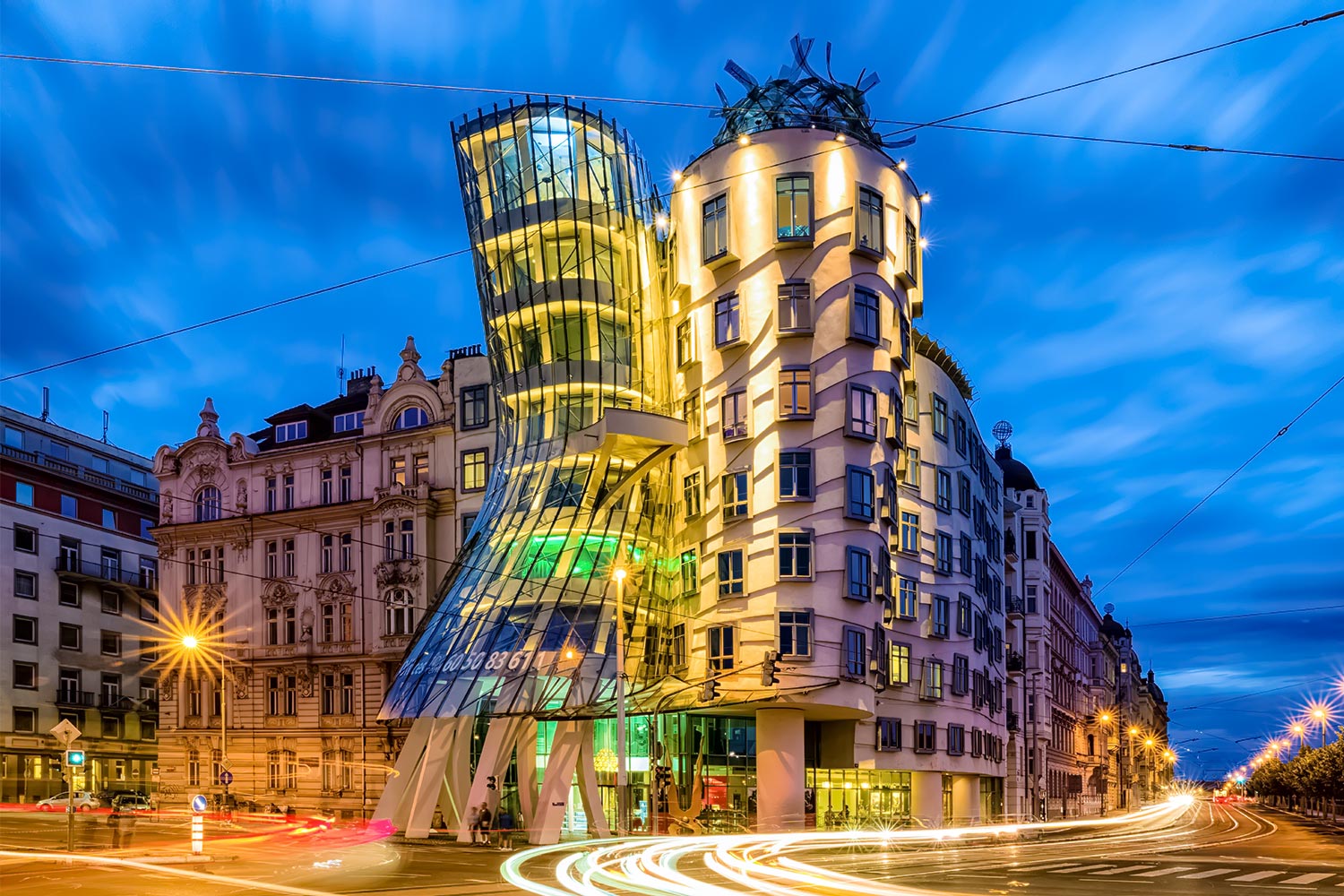
This deconstructivist masterpiece features two towers: a glass “female” one narrowing midway and a concrete “male” one with a metal dome. Supported by 99 unique concrete panels, the building has undulating molds, unaligned windows with protruding frames, and a twisted metal “Medusa” atop. It spans nine floors above ground and two below, with asymmetric rooms and ship-like interiors by Eva Jiřičná. The design blends with Prague’s historic skyline while standing out, using perspective tricks to match neighboring 19th-century heights.
Why It’s Unique and Visitor Attractions
The Dancing House is unique for its anthropomorphic “dancing” shape in a city of Gothic and Baroque styles, representing yin-yang harmony. It won Time magazine’s design contest in 1997 and appears on a Czech coin. Visitors flock to the Rašínovo nábřeží location for exterior views, the Ginger & Fred restaurant, a hotel with themed suites, art gallery, and glass bar. Nighttime illuminations enhance its allure. Fun fact: Gehry initially rejected the dancer nickname to avoid kitsch, but it stuck. As one of Prague’s top attractions, it offers panoramic Vltava River views.
