

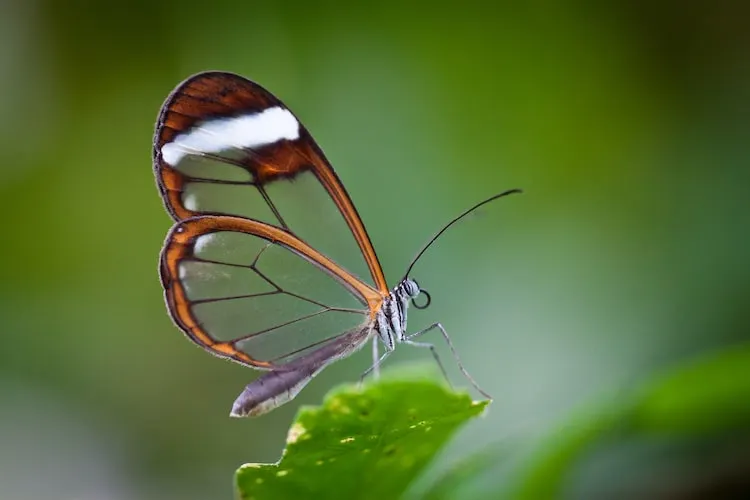
The butterfly is often celebrated for its vibrant colors, but the Glasswing butterfly stands out for a completely different reason. Unlike most butterflies, the Glasswing (Greta oto) possesses transparent wings, allowing it to blend seamlessly into its environment. This unique adaptation makes it one of the most intriguing species in the insect world.
Appearance and Structure
Glasswing butterflies have wings that appear almost invisible at first glance. Their wings are primarily composed of transparent membranes bordered with black and occasionally tinged with orange or red. The transparency is due to a lack of colored scales, which are present in other butterfly species. This adaptation allows the butterfly to avoid predators by becoming nearly invisible against leaves and flowers.
Habitat and Distribution
Glasswing butterflies are native to Central and South America, especially in countries such as Mexico, Panama, and Colombia. They are commonly found in forested areas, along rivers, and near gardens that provide nectar-rich flowers. These butterflies thrive in warm, humid environments, making tropical rainforests their perfect habitat.
Feeding Habits
The Glasswing butterfly feeds primarily on nectar from flowers. They have a long proboscis, a tube-like tongue, which allows them to reach deep into flowers. Interestingly, they also feed on the juice of rotting fruits and tree sap to supplement their diet. This varied feeding behavior helps them gain essential nutrients needed for survival.
Predators and Defense Mechanisms
Transparency serves as the Glasswing’s main defense mechanism. By blending into its surroundings, it becomes less visible to birds and other predators. Additionally, its bright wing edges can serve as a warning for potential predators that the butterfly may not be palatable.
Reproduction and Life Cycle
Like other butterflies, Glasswings undergo complete metamorphosis. Eggs are laid on the underside of host plants. Caterpillars feed on these plants, eventually forming a chrysalis. After metamorphosis, the adult butterfly emerges with its iconic transparent wings, ready to continue the cycle.
Conservation Status
Although not currently endangered, Glasswing populations are affected by habitat loss due to deforestation. Preserving rainforests and maintaining flower-rich environments are crucial for the survival of these remarkable insects.
The Glasswing butterfly is a living example of nature’s ingenuity. Its transparent wings not only fascinate scientists and enthusiasts alike but also demonstrate how evolution equips species with incredible survival tools. Observing a Glasswing in its natural habitat is truly witnessing a masterpiece of adaptation.
