
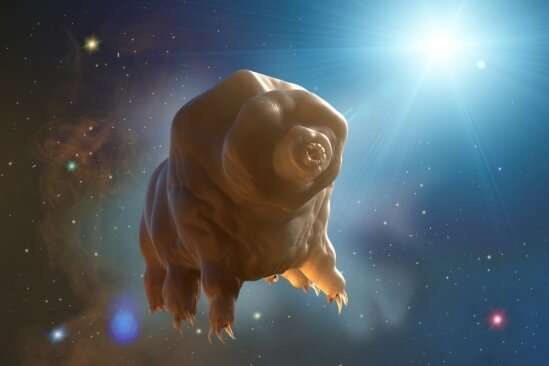
Tardigrades, often nicknamed “water bears” or “moss piglets,” are microscopic creatures that have captivated scientists with their unparalleled resilience. These eight-legged invertebrates, measuring just 0.5 millimeters on average, thrive in environments where no other animals can survive. From the depths of the ocean to the peaks of mountains, tardigrades have been found everywhere on Earth. But their most astonishing feat? Surviving the vacuum of outer space. In this article, we’ll explore what makes these tiny titans so tough, their groundbreaking space experiments, and why they might hold keys to future space exploration.
What Are Tardigrades?
Tardigrades belong to the phylum Tardigrada, with over 1,300 known species. They resemble plump, segmented bears under a microscope, complete with claws on each leg for gripping surfaces like moss or lichen. First discovered in 1773 by German zoologist Johann August Ephraim Goeze, they were later dubbed “little water bears” by Lazzaro Spallanzani. These creatures inhabit moist environments but can enter a state called cryptobiosis, where they suspend all metabolic processes to endure extremes.
In their active state, tardigrades feed on plant cells, algae, or small invertebrates. They reproduce through eggs, with some species capable of parthenogenesis (asexual reproduction). Their bodies are 85% water when hydrated, but in harsh conditions, they lose nearly all of it, shrinking into a desiccated “tun” form that looks like a wrinkled barrel.
Survival in Extreme Conditions
Tardigrades are extremophiles, surviving temperatures from -458°F (-272°C) near absolute zero to over 300°F (150°C). They withstand pressures six times greater than the deepest ocean trenches and radiation doses 1,000 times higher than lethal for humans. In cryptobiosis, their metabolism drops to 0.01% of normal, allowing survival without food or water for decades.
This resilience stems from unique proteins like tardigrade-specific intrinsically disordered proteins (TDPs), which protect cellular structures during dehydration. They also produce antioxidants to combat radiation damage and can repair DNA breaks efficiently. In lab tests, revived tardigrades have lived up to 30 years in this state, though typical lifespans are months.
Groundbreaking Space Experiments
In 2007, the European Space Agency’s FOTON-M3 mission exposed dehydrated tardigrades to space’s vacuum and solar UV radiation for 10 days. Remarkably, 68% of those shielded from UV revived upon rehydration, with many producing healthy offspring. Even some exposed to full UV survived, making tardigrades the first animals to endure open space. NASA’s 2021 mission sent tardigrades to the International Space Station to study microgravity effects on their genes.
In 2019, an Israeli lunar lander crash-landed thousands of tardigrades on the Moon. While they likely entered cryptobiosis, revival would require water improbable on the lunar surface. These experiments highlight tardigrades’ potential for astrobiology, suggesting life could travel between planets via panspermia.
How Do They Survive the Vacuum of Space?
Space’s vacuum causes fluids to boil and expand, lethal for most organisms. Tardigrades counter this by dehydrating into tuns, expelling water to prevent boiling. Their cuticle acts as a protective suit against cosmic rays. Studies show they upregulate genes for DNA repair and protein protection in space-like conditions.
Research at the University of Wyoming, led by Dr. Thomas Boothby, reveals TDPs form glass-like structures that stabilize cells. This “vitrification” prevents damage from freezing or drying. In radiation tests, tardigrades survived doses equivalent to 1,000 years of human exposure.
Implications for Science and Space Travel
Tardigrades inspire biotechnology, from drought-resistant crops to vaccines stable without refrigeration. Their proteins could protect astronauts from space radiation. Future missions may use engineered tardigrade genes for human space colonization.
As climate change intensifies extremes on Earth, studying tardigrades offers insights into resilience. These water bears remind us that life finds a way, even in the cosmos’ harshest voids. Whether on moss or the Moon, tardigrades prove size doesn’t limit survival.
