

Icebergs with internal caves represent one of nature’s most awe-inspiring phenomena, where sunlight transforms frozen masses into glowing blue sanctuaries. These structures, often formed from ancient glacial ice, captivate explorers and scientists alike. This article explores their formation, the science behind the blue glow, ecological significance, and the threats they face in a warming world.
How Iceberg Caves Form: A Dance of Nature’s Forces
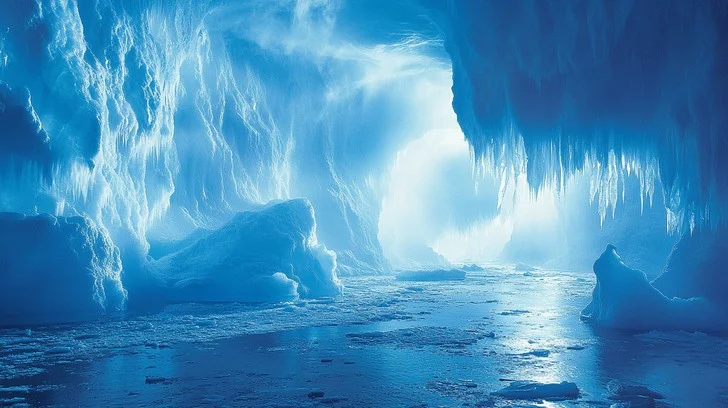
Iceberg caves emerge when massive ice chunks calve from glaciers, exposing compressed ice layers to erosion. Wind, waves, and meltwater carve tunnels and chambers inside, creating ethereal voids. In regions like Antarctica and Iceland, these caves often form in “blue ice” dense, bubble-free layers from centuries of compression. The process begins with crevasses in glaciers widening under pressure, then evolving into caves as the iceberg drifts. Sunlight penetrating these openings illuminates the interior, revealing smooth walls sculpted by natural forces.
The caves’ shapes vary: some are narrow tunnels, others vast chambers resembling cathedrals. In Vatnajökull, Europe’s largest glacier, meltwater from summer thaws accelerates cave formation, while winter freezes preserve them. This cyclical process ensures dynamic, ever-changing structures, with some caves lasting only seasons before collapsing.
The Science of the Blue Glow: Light’s Magical Interaction with Ice
The hallmark of these caves is their natural blue glow, a result of light physics. Sunlight, comprising all colors, enters the ice, where longer red wavelengths are absorbed, leaving shorter blue ones to scatter and dominate. This Rayleigh-like scattering, combined with ice’s purity, creates an intense azure hue. In denser ice, free of air bubbles, light travels farther, intensifying the blue.
Observations in Antarctic icebergs show caves glowing brighter during low-angle sunlight, like dawn or dusk, when rays penetrate deeper. The glow isn’t uniform; volcanic ash layers can add dark streaks, contrasting the blue. This phenomenon mirrors why deep ocean water appears blue but on a frozen scale, making caves feel otherworldly.
Ecological and Geological Significance
These caves serve as microhabitats, hosting algae and microorganisms adapted to cold, low-light conditions. In polar regions, they provide insights into climate history through trapped air bubbles, revealing past atmospheric compositions. Geologically, they expose glacial layers, aiding studies on ice flow and erosion.
For wildlife, caves offer shelter; seals and penguins sometimes use them as haul-outs. In Jökulsárlón Lagoon, Iceland, floating icebergs with caves create serene lagoons, supporting diverse ecosystems. They also influence ocean currents by releasing freshwater upon melting, affecting salinity and marine life.
Exploration and Tourism: Safely Experiencing the Glow
Adventurers flock to sites like Antarctica’s ice caves for guided tours, using crampons and helmets for safety. Photography captures the glow’s nuances, with drones revealing hidden angles. However, risks like sudden collapses necessitate expert guidance.
Tourism boosts awareness but requires sustainability; regulations limit visitor numbers to preserve these fragile wonders.
Climate Change Threats and Conservation Efforts
Rising temperatures accelerate iceberg calving and cave instability, with many vanishing faster than they form. Studies predict increased melting, diminishing these spectacles. Conservation involves monitoring via satellites and advocating reduced emissions.
In essence, iceberg caves embody nature’s artistry, where sunlight and ice converge in blue brilliance. Protecting them ensures future generations witness this frozen magic.
