



The flying snake is one of the most surprising and misunderstood creatures in the natural world. Although it does not have wings, this remarkable reptile can glide through the air with impressive control and distance. Found primarily in South and Southeast Asia, flying snakes have evolved a unique method of locomotion that allows them to move from tree to tree without ever touching the ground. Their strange yet fascinating ability has made them a subject of research for biologists, engineers, and nature enthusiasts.
A Snake That Glides Through the Air
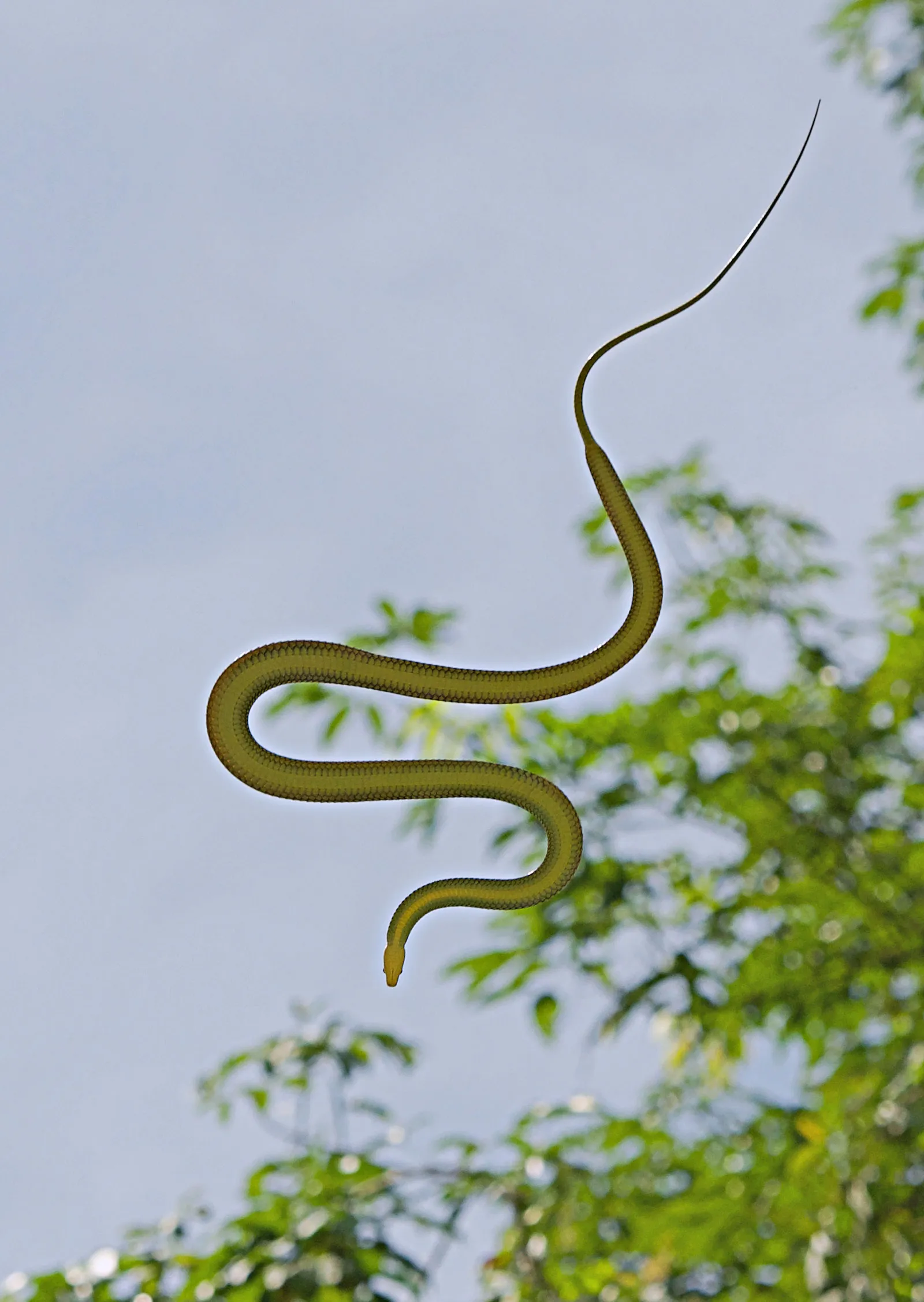
Flying snakes belong to the genus Chrysopelea. Despite their name, they do not truly fly. Instead, they glide using a combination of body flattening and graceful midair movement. They can launch themselves from tree branches and travel distances of up to one hundred meters. Their movement is so smooth and controlled that observers often describe it as flying.
What makes their glide impressive is that the snake must stabilize its body while airborne, resist air drag, and maintain direction. Even without wings or limbs, it performs these tasks with surprising skill.
How Flying Snakes Glide
The flying snake’s gliding ability depends on a special technique. First, it climbs to a high branch using its strong belly scales. When it is ready to glide, it hangs from the edge, forms a J shape, and pushes off into the air.
Once airborne, the snake flattens its ribs to transform its round body into a wide and concave shape. This creates a parachutelike aerodynamic surface. The snake then undulates its body in a wave pattern, allowing it to steer and control its descent. By adjusting its movements, it can turn left or right, slow down, or extend its glide farther.
Researchers have found that flying snakes are more stable in the air than many birds or flying squirrels. Their gliding ability is a result of efficient natural engineering.
Adaptations Built for the Forest
Flying snakes live in dense forests where trees are tall and closely spaced. Gliding provides a fast and energy efficient way to move from one point to another. Instead of climbing down and back up again, the snake simply leaps and glides to its next destination.
Their slender bodies and lightweight frames make them excellent climbers and gliders. The scales on their bellies allow them to grip bark, while their flexible ribs give them shape shifting abilities needed to glide.
Not Dangerous to Humans
Although they look intimidating, flying snakes are generally harmless to people. They are mildly venomous, but their venom is used primarily for small prey such as lizards, frogs, and birds. Their fangs are located at the back of their mouths, making them highly unlikely to harm humans.
Their diet consists mostly of small animals found in treetops. Their agility allows them to chase prey among branches or ambush from above.
Why Flying Snakes Glide
There are several reasons why flying snakes glide. The most common explanation is mobility. Gliding helps them travel more efficiently in the forest canopy. Another reason is escape. By leaping into the air, they can avoid predators or reach a safe branch quickly. Gliding also helps them hunt by allowing silent and swift movement through the trees.
This form of locomotion is an example of evolution finding creative solutions to environmental challenges. The snake’s body, although simple in structure, is capable of performing aerodynamic feats that surprise even scientists.
Inspiration for Science and Engineering
The flying snake’s movement has become a subject of interest in biomimicry and aerodynamics research. Engineers study the snake’s gliding technique to understand how flexible bodies interact with air. This research may inspire new designs in robotics, drones, and rescue equipment that need to move efficiently through complex environments.
High speed cameras and computer simulations have allowed scientists to analyze the snake’s midair motion in detail. The findings continue to show that these reptiles perform advanced aerodynamic maneuvers with no wings or limbs.
The flying snake is one of nature’s most remarkable creatures. Its ability to glide without wings, its precision in the air, and its unique adaptations make it an astonishing example of evolutionary innovation. Whether viewed from a scientific, environmental, or educational perspective, the flying snake proves that the natural world still holds many surprises.
