

The Alaskan wood frog is one of the most extraordinary animals on Earth. This small amphibian has a biological ability that seems impossible at first glance. It can freeze solid during the harsh winter months, remain in a suspended state for weeks or months, and then thaw back to life when spring returns. Because of this remarkable survival strategy, the Alaskan wood frog has become a subject of global scientific fascination. Its unique adaptation reveals how far nature can go in helping species survive extreme environments.
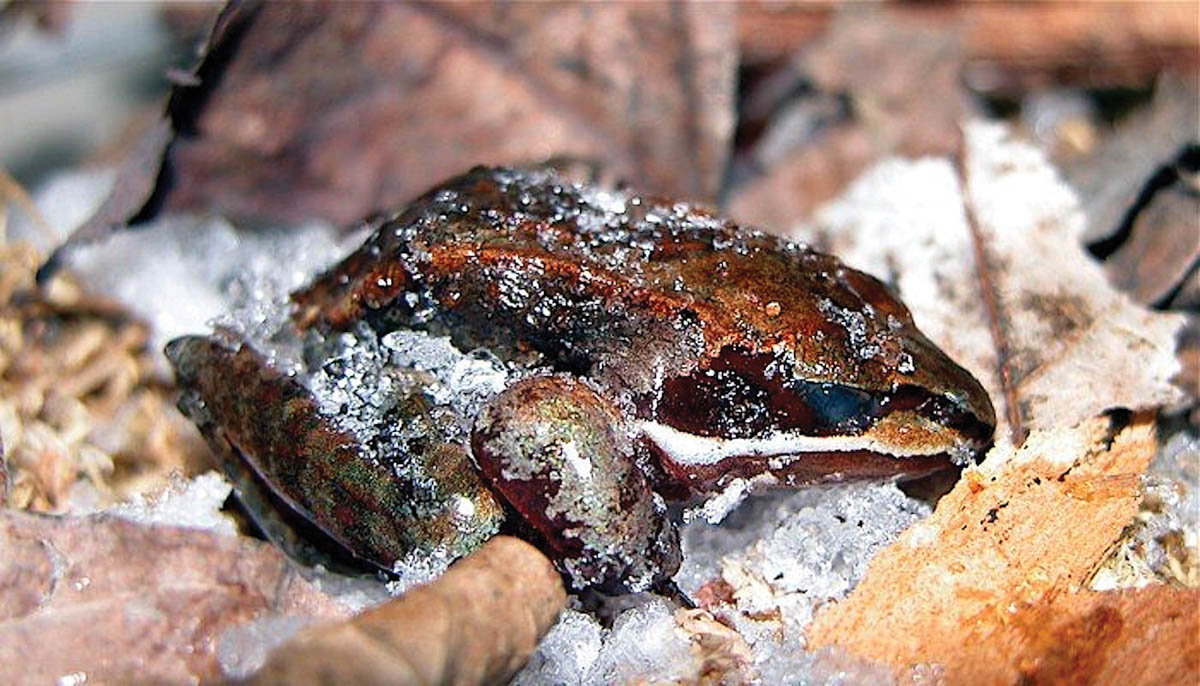
The Alaskan wood frog lives in some of the coldest regions in North America, including Alaska, Canada, and parts of the Arctic. Winter temperatures in these areas can drop far below freezing. Most animals survive by migrating, hibernating underground, or relying on body heat insulation. However, the Alaskan wood frog takes a different approach. Instead of avoiding the cold, it lets itself freeze. Up to two thirds of the water in its body can turn into ice. Its heart stops beating, its lungs stop functioning, and its brain activity nearly disappears.
Despite appearing dead, the frog is very much alive. The key to its survival lies in its biochemistry. When the temperature begins to drop, the frog’s liver produces large amounts of glucose. This sugar acts as a natural antifreeze inside the frog’s cells. While the water outside the cells freezes, the glucose inside protects the cells from forming ice crystals that would normally cause fatal damage. In simple terms, the frog prevents its vital tissues from freezing completely even when the rest of its body becomes solid.
The frog enters a frozen state throughout the winter. During this time, it does not breathe, drink, or move. Its bodily functions pause in a form of suspended animation. When spring arrives and temperatures rise again, the ice inside its body melts. The frog’s heart begins to beat once more, its lungs restart, and its muscles slowly regain movement. Within a few hours, the frog is fully active as if nothing happened. This natural revival process is one of the most astonishing phenomena in animal biology.
Scientists have studied the Alaskan wood frog for decades because its survival mechanisms could inspire breakthroughs in medicine. One area of interest is organ preservation. Today, human organs for transplants can only be kept viable for a short time because freezing causes irreversible cell damage. The frog’s ability to avoid this damage has encouraged researchers to explore new methods that could significantly extend the life of donated organs. Its biology could also influence advancements in cryopreservation, which aims to preserve biological samples at extremely low temperatures.
The Alaskan wood frog’s freezing ability is also important for ecological reasons. By surviving winter in a frozen state, the frog can remain in the same habitat year round and reproduce during the spring season. This early breeding advantage allows it to lay eggs sooner than other amphibians. As a result, the species plays a vital role in the food chain, supporting predators such as birds, snakes, and mammals.
The frog’s adaptation is closely linked to its environment. Alaska and Arctic regions experience long winters and short summers. Freezing is the frog’s solution to surviving in an area where burrowing deep underground is difficult and where winter lasts far too long for normal hibernation. Over thousands of years, natural selection shaped the frog’s biology to match these extreme conditions, making it one of the most resilient amphibians in the world.
Visually, the Alaskan wood frog might appear simple. It is small, usually brown or tan, and blends easily with forest leaf litter. Yet under its modest appearance lies one of the most powerful survival adaptations in the animal kingdom. Wildlife enthusiasts often seek out this species to learn more about its behavior, while researchers continue to expand their understanding of how the frog’s biochemical processes work during freezing and thawing.
The phenomenon of freezing and revival also sparks curiosity among readers and nature lovers. Many find it fascinating that an animal can stop its heartbeat and still return to life without any permanent damage. This unique survival strategy challenges common assumptions about life and death. It shows how diverse biological systems can be in overcoming extreme environmental challenges.
As climate patterns shift, scientists are monitoring the future of the Alaskan wood frog. Changes in winter conditions or habitat temperature could influence the frog’s freezing cycle. Understanding how the species adapts will help researchers predict how other cold dwelling creatures may respond to global climate changes. The frog remains an iconic example of nature’s ability to innovate in the face of environmental extremes.
The Alaskan wood frog continues to amaze scientists, nature enthusiasts, and even medical researchers. Its extraordinary ability to freeze solid and revive each year is a reminder that life on Earth is full of unexpected wonders. This small amphibian stands as a powerful symbol of resilience and adaptation. With ongoing research, the secrets of the Alaskan wood frog may one day lead to scientific advances that benefit humans while deepening our appreciation of the natural world.
