


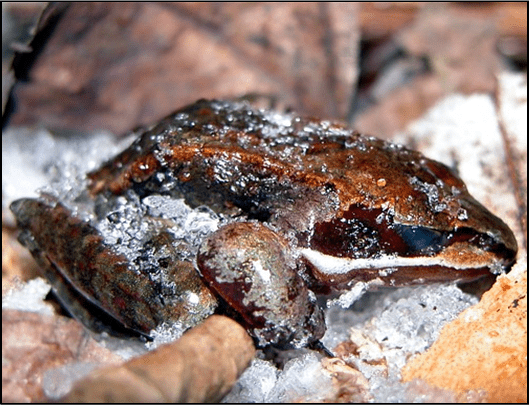
The so called zombie frog refers to the wood frog, a species capable of surviving complete freezing during winter. In this frozen state, the frog shows no heartbeat, no breathing, and no detectable brain activity. Despite appearing biologically dead, it can return to life when temperatures rise.
How the Frog Appears to Die
This extraordinary ability has fascinated scientists and earned the frog its dramatic nickname.
During winter, wood frogs allow up to 65 percent of their body water to freeze. Ice forms around their organs, stopping circulation and oxygen flow to the brain.
At this stage:
- The heart stops beating
- Breathing completely ceases
- Brain activity becomes undetectable
By normal biological standards, this would mean death.

The Chemistry Behind Reanimation
The secret to survival lies in a natural antifreeze system. As freezing begins, the frog’s liver releases massive amounts of glucose into its bloodstream.
This glucose:
- Protects cells from ice damage
- Prevents dehydration
- Stabilizes cell membranes
Some species also produce urea to further protect tissues.
Revival When Spring Arrives
When temperatures rise, ice melts gradually inside the frog’s body. The heart restarts, blood begins flowing, and brain activity returns.
Within hours, the frog can hop away as if nothing happened.
Evolutionary Advantage
This ability allows the wood frog to survive in regions where temperatures drop below freezing for months. By tolerating freezing rather than avoiding it, the frog occupies habitats other amphibians cannot.
Scientific Importance
Zombie frogs are studied for:
- Organ preservation research
- Cryogenic medicine
- Stroke and cardiac arrest treatment
Understanding how cells survive without oxygen could help save human lives.
The zombie frog challenges our definition of death. Its ability to shut down and restart vital systems proves that life can persist in ways science is still trying to fully understand.
