

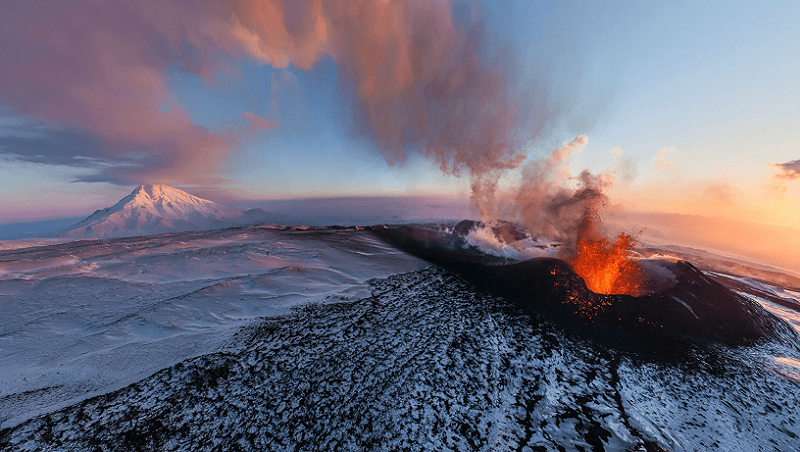
Mount Erebus is one of the most fascinating volcanoes on Earth. Located on Ross Island in Antarctica, it is famous for a rare natural feature that sets it apart from other volcanoes. While many mountains erupt with violent explosions, Mount Erebus often displays constant small flames that burn inside its crater. These glowing flames come from volcanic gases that ignite as they escape from the magma below. Scientists consider Mount Erebus a natural laboratory because it offers a rare view into the inner workings of an active volcano.
A Unique Volcano in Antarctica
Mount Erebus rises more than three thousand seven hundred meters above sea level, making it one of the tallest active volcanoes in the world. It is also the southernmost active volcano on Earth. Its location in Antarctica gives it an environment unlike any other volcano. The mountain is covered by snow and ice, yet beneath this frozen landscape lies a lake of molten lava that stays active throughout the year. The contrast of fire and ice creates a dramatic sight that attracts scientists from different fields.
The harsh climate around Mount Erebus makes access difficult. Temperatures can drop far below freezing and storms are common. Despite these challenges, researchers continue to visit the mountain because of its unique geological activity. Erebus is one of the few volcanoes that has a long lasting lava lake. Very few volcanoes in the world have this feature, which allows scientists to directly observe volcanic processes over long periods of time.
The Origin of the Constant Small Flames
The small flames seen on Mount Erebus are produced by burning volcanic gases. When gas escapes through cracks around the lava lake, it can ignite and create flames that flicker gently like candles. These flames are not large eruptions. Instead, they are subtle but continuous signs that the volcano is active. The gases that fuel the flames include methane, hydrogen and other flammable compounds. When they mix with oxygen and heat from the lava lake, the result is a natural flame.
These flames are sometimes called fumarole flames. Fumaroles are openings in the Earth where volcanic gases escape. On most volcanoes the gases simply rise into the air. On Erebus however the conditions allow some of these gases to ignite. The flames can appear blue, yellow or orange depending on the gas mixture and temperature.
What Makes Mount Erebus Special
Mount Erebus is not only known for its flames. Another unusual feature is its persistent lava lake. This lake has been active for decades and allows scientists to monitor volcanic activity in real time. The lake constantly moves and bubbles as gas escapes from the molten rock below. It provides important information about pressure changes, magma composition and potential eruption patterns.
In addition to the lava lake, Erebus is known for producing unique volcanic rocks called Erebus crystals. These crystals are formed from anorthoclase feldspar that grows inside the lava. The crystals are often large and beautifully shaped, making them scientifically interesting and visually striking.
Scientific Research on Mount Erebus
Since the 1970s, scientists from different countries have conducted research missions on Mount Erebus. Their work includes studying gas emissions, monitoring seismic activity and analyzing the lava lake. Because Erebus is located in such an isolated and stable environment, it provides clear data without the interference often seen at more accessible volcanoes.
The constant flames and lava lake help researchers understand how gases travel through magma and how pressure builds inside a volcano. This research can support better predictions of volcanic eruptions in other regions of the world. Erebus acts as a natural open window into processes that are usually hidden deep beneath the Earth.
The Harsh Environment Surrounding Erebus
The area around Mount Erebus is cold, windy and remote. It is one of the few places on Earth untouched by human development. The only nearby settlement is McMurdo Station, a scientific research base located about forty kilometers away. Travel to the mountain requires special equipment because of the ice fields, crevasses and unpredictable weather.
Despite these difficult conditions, the landscape is breathtaking. Pure white snow fields stretch for miles, and the dark volcanic peak rises above them. When flames and lava glow inside the crater, the light reflects on the surrounding steam and clouds, creating a dramatic and almost surreal scene.
Mount Erebus and Its Global Significance
Although Mount Erebus is far away from major population centers, its scientific value is worldwide. The volcano helps researchers learn more about Earth’s interior and the behavior of magma. Understanding these processes can improve hazard assessments for other active volcanoes. The study of volcanic gases at Erebus also contributes to climate research because some gases influence atmospheric chemistry.
The constant flames add an element of mystery to the mountain. They show that volcanic activity is not always explosive. Sometimes it is calm, persistent and quietly beautiful. The flames are a reminder that Earth is constantly changing below the surface, even in the coldest and most remote places.
A Natural Wonder at the Edge of the World
Mount Erebus stands as one of the most extraordinary natural wonders on the planet. Its combination of ice, fire and isolation creates a landscape unlike any other. The mountain’s constant small flames and long lasting lava lake offer rare insights into volcanic processes. For scientists, it is a valuable site for research. For nature lovers, it is a symbol of the raw and powerful forces that shape the Earth.
