
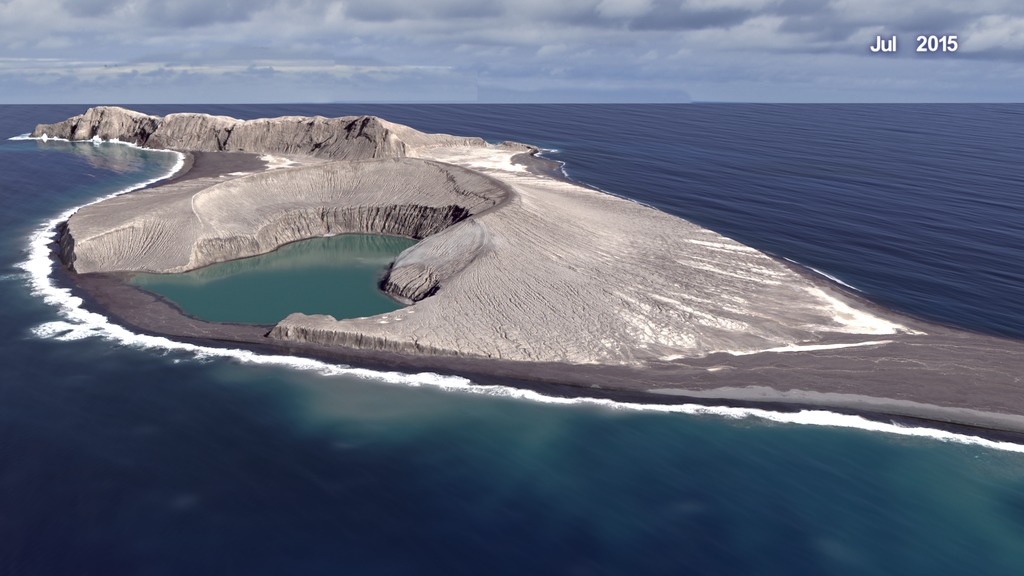
In September 2022, a remarkable event unfolded in the remote South Pacific: a tiny nameless island suddenly emerged from the ocean depths near Tonga, created by an underwater volcanic eruption at the Home Reef seamount. This fresh piece of land often simply called the “new island” or “unnamed island” appeared just 11 hours after the eruption began on September 10, showcasing the raw power of Earth’s geology in one of the world’s most active volcanic regions.
Here are stunning satellite and aerial views of the newborn island shortly after its formation, captured by NASA and other observatories:
The Birth of a Nameless Volcanic Island
The Home Reef volcano, part of the Tonga volcanic arc in the Central Tonga Islands, erupted with plumes of steam, ash, and oozing lava. Within hours, cooled lava and volcanic material piled up to break the ocean surface, forming a small circular island. By mid-September, it had grown rapidly:
- September 14: ~4,000 square meters (~1 acre), 10 meters (33 ft) above sea level
- September 19–20: Expanded to ~8.6 acres (~35,000 square meters), reaching ~50 feet (15 meters) high
This quick growth turned the surrounding water a striking greenish hue from discolored plumes rich in sulfur and volcanic particles a classic sign of active submarine volcanism.
Witness the dramatic eruption plumes and discolored ocean in these NASA satellite captures:
Why “Nameless”? And Will It Last?
Unlike famous volcanic islands, this one remains officially unnamed a true “nameless island” in scientific reports and media. Home Reef has a long history of such events, producing temporary islands in 1852, 1857, 1984, and 2006, most of which eroded away due to relentless Pacific waves and currents.
While some newborn islands (like one from nearby Late’iki in 1995) survived for decades, experts predict this tiny landmass may disappear relatively soon. Ongoing eruptions through 2024–2025 have added more material, growing it further in some updates but its future remains uncertain in this dynamic volcanic hotspot.
These images show the raw, steaming landscape of fresh volcanic rock and ash:
Nature’s Laboratory in the Ring of Fire
The Tonga region boasts the highest density of underwater volcanoes on Earth, thanks to the subduction of the Pacific Plate. Events like this offer scientists a front-row seat to study rapid land formation, marine ecosystem recovery, and the effects of volcanic nutrients on ocean life.
This nameless island reminds us how Earth continues to reshape itself creating new land one eruption at a time, even if only for a fleeting moment in geological time.
