




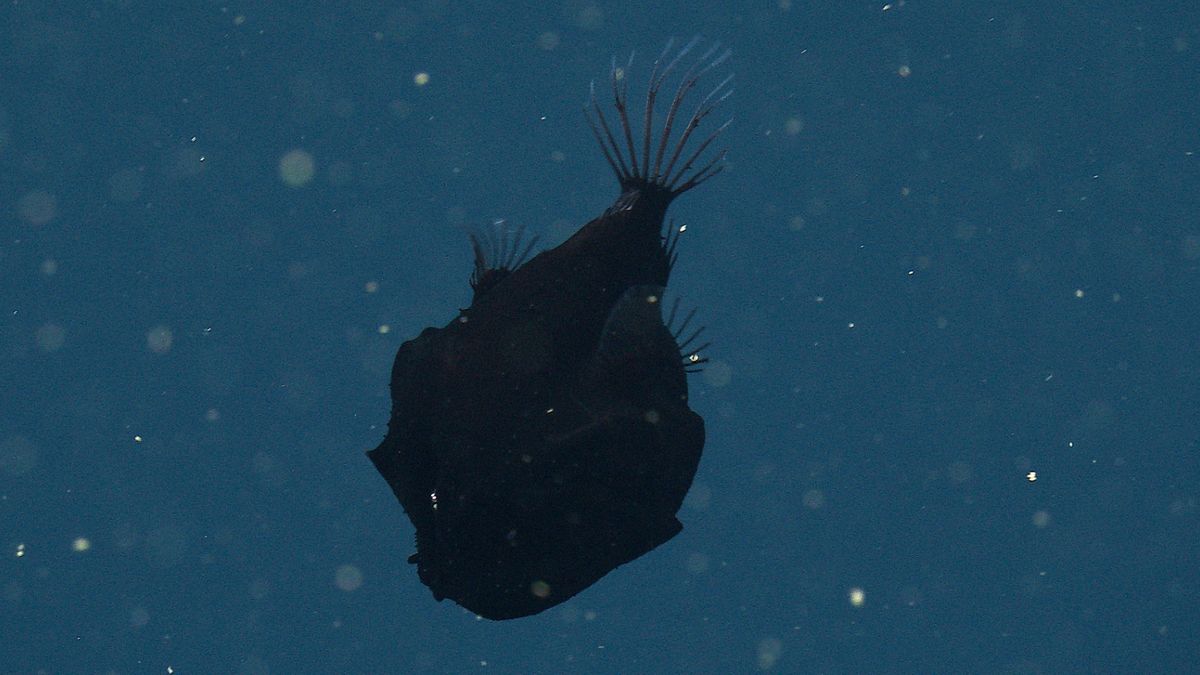
In the pitch-black depths of the ocean, where sunlight never reaches, survival often depends on remaining unseen. Here, deep-sea fish have evolved one of nature’s most extraordinary camouflage techniques: ultra-black skin that absorbs more than 99.5% and in some cases up to 99.95% of all light that strikes it. This makes them virtually invisible, even when illuminated by the faint glow of bioluminescent creatures around them.
These remarkable animals, often called “ultra-black” or “superblack” deep-sea fish, represent one of the blackest naturally occurring materials on Earth rivaling human-made substances like Vantablack.
Why Do Deep-Sea Fish Need to Be So Black?
The deep ocean (below 200–1,000 meters) is a world of perpetual darkness, but it’s not completely lightless. Many marine organisms produce bioluminescence glowing lights used to attract mates, confuse predators, or lure prey. In this eerie twilight:
- A flash of light can expose a fish to hungry predators.
- Predators with glowing lures (like anglerfish) need to hide their own bodies so prey doesn’t spot the danger before the glowing bait.
Ultra-black skin solves this problem by swallowing almost every photon of light, preventing reflections that could reveal the fish’s shape or position.
How Does Ultra-Black Skin Work?
The secret lies in melanin, the same pigment that colors human skin and hair. In these fish, melanin is packed into tiny structures called melanosomes pigment-filled compartments inside skin cells.
Unlike regular black animals, ultra-black deep-sea fish arrange these melanosomes in a unique way:
- They form a dense, continuous layer right at the skin’s surface.
- The melanosomes are elongated (like tiny tic-tacs) and packed so tightly that there are almost no gaps.
- Any light that isn’t immediately absorbed gets redirected sideways into neighboring melanosomes, which then trap it completely.
This simple yet highly efficient system allows the skin to absorb light far better than the bumpy, nanostructured surfaces found in ultra-black birds or butterflies.
Examples of Ultra-Black Deep-Sea Fish
Scientists have identified at least 16 species with this adaptation, many of them distantly related, showing that ultra-black skin evolved independently multiple times.
Here are some of the most striking examples:
- Common Fangtooth (Anoplogaster cornuta) A ferocious-looking predator with massive teeth, whose skin reflects less than 0.5% of light.
- Pacific Blackdragon (Idiacanthus antrostomus) A long, eel-like fish with glowing lures; its ultra-black body helps it sneak up on prey undetected.
- Deep-Sea Dragonfish Equipped with bioluminescent barbels, they use their darkness to approach prey without warning.
- Tiny Anglerfish (genus Oneirodes) Among the blackest of all, reflecting as little as 0.04–0.05% of light making them some of the darkest animals known.
These fish often appear as mere silhouettes even in bright lab lights because they absorb virtually everything.
What Can We Learn from Ultra-Black Fish?
Beyond their alien beauty, these fish could inspire new technologies. Their simple, pigment-based light-trapping method is cheaper, more flexible, and less fragile than current ultra-black materials used in telescopes, cameras, solar panels, and military camouflage.
Nature once again proves it often finds the most elegant solutions to extreme challenges in this case, turning almost perfect darkness into the ultimate invisibility cloak.
The next time you imagine the deep sea, picture these ghostly black predators gliding silently, unseen shadows in an already lightless world. They’re not just surviving they’re mastering the art of disappearing completely.
