




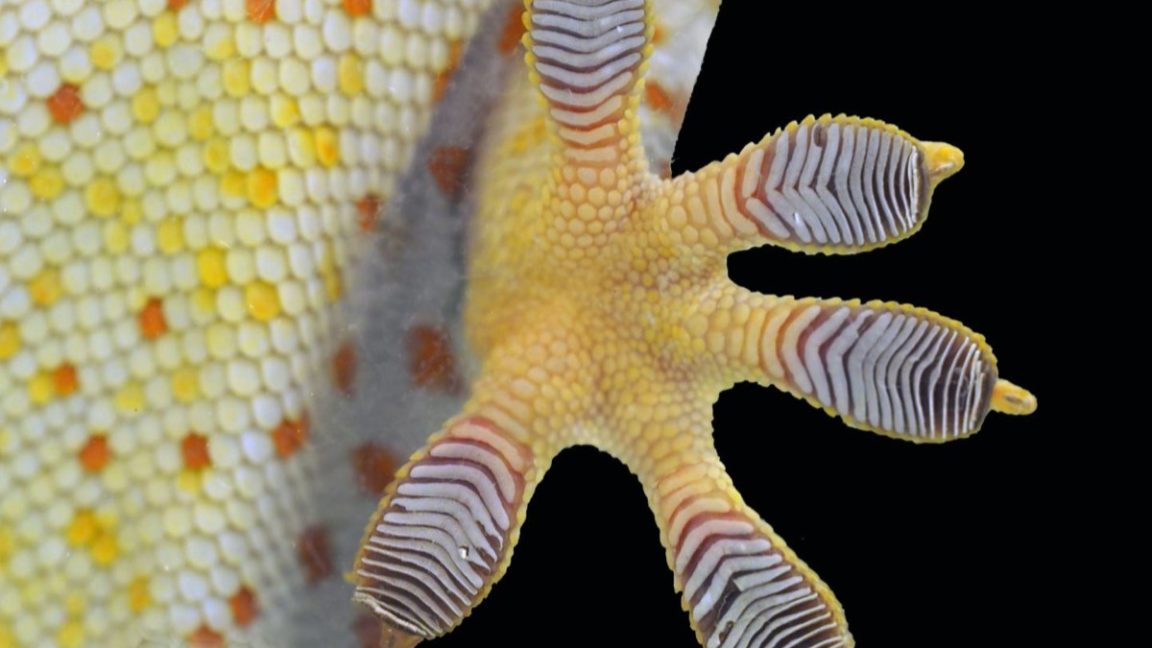
Ever wondered how geckos effortlessly scamper up smooth glass walls, across ceilings, or even hang upside down without slipping? These incredible lizards defy gravity with a superpower that’s inspired scientists and engineers worldwide. Let’s uncover the secret behind the gecko’s amazing climbing ability!
How Do Geckos Stick to Walls?
Geckos don’t use glue, suction cups, or Velcro. Their secret lies in tiny hair-like structures called setae on the bottoms of their feet.
- Each toe pad is covered in millions of microscopic setae (up to 14,000 per square millimeter!).
- These setae split into even tinier tips called spatulae, creating billions of contact points.
- The sticking power comes from van der Waals forces weak molecular attractions that add up to a strong grip when multiplied by billions.
- This dry adhesion works on almost any surface: wet, dry, rough, or ultra-smooth like glass.
Close-up views of gecko feet and setae under the microscope:
Geckos in Action: Climbing Smooth Surfaces
The most famous wall-climbers are species like the Tokay Gecko (Gekko gecko), known for effortlessly scaling vertical glass or even running upside down on ceilings.
Watch them defy physics:
Even upside down on ceilings no problem!
Why Don’t They Fall?
Geckos control their grip by angling their toes. Peeling them off like tape releases the adhesion instantly, allowing quick movement. A single toe can support their entire body weight!
Real-World Inspiration
This natural technology has led to gecko-inspired adhesives used in robotics, medical patches, and even prototypes for humans climbing walls.
Fun Facts About Climbing Geckos
- A gecko can support up to 20 times its body weight on one foot.
- They clean their feet by licking them to maintain stickiness.
- Over 1,500 gecko species exist, but not all climb equally well Tokays are among the best.
Nature’s engineering at its finest! Geckos prove that sometimes the smallest features create the biggest superpowers. Curious about other gravity-defying animals or how this tech is used in robots? Let me know!
