




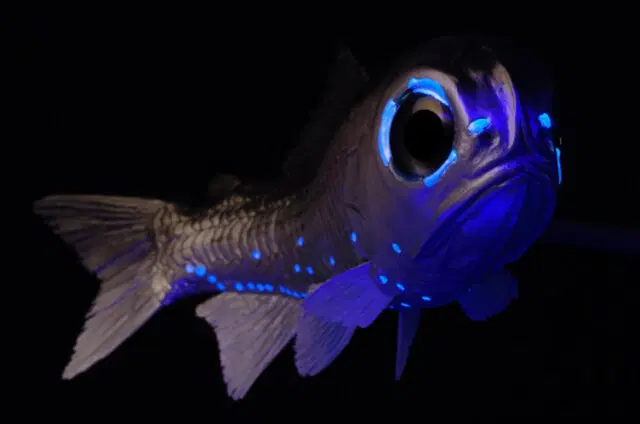
Lanternfish, belonging to the family Myctophidae, are among the most abundant and fascinating vertebrates in the ocean. These small fish, typically 2-15 cm long, dominate the mesopelagic zone and are renowned for their ability to generate and precisely control their own light through bioluminescence. This adaptation helps them survive in the perpetual darkness of the deep sea.
What Are Lanternfish and Why Are They Special?
Lanternfish are found in all major oceans, with over 250 species. They perform daily vertical migrations, ascending to shallower waters at night to feed and descending during the day to avoid predators. Their bioluminescent organs, called photophores, line their bodies, especially on the underside.
How Lanternfish Control Their Own Light
Bioluminescence in lanternfish results from a chemical reaction involving luciferin and luciferase, often aided by symbiotic bacteria in some species. They control light intensity, duration, wavelength (usually blue-green for deep-sea penetration), and patterns. The key adaptation is counter-illumination: ventral photophores emit light matching the downwelling surface light, eliminating their silhouette when viewed from below. This camouflage confounds predators. They also use lights for communication, schooling, prey attraction, and startling threats. Neural and muscular control allows rapid on/off switching.
Habitat and Distribution
Lanternfish inhabit the twilight zone (200-1,000 meters), preferring cold, oxygen-rich waters. They are most abundant in the Southern Ocean and upwelling zones. Their massive biomass—estimated at billions of tons—makes them a keystone species.
Ecological Importance and the Marine Food Web
They link primary producers to top predators. Lanternfish consume zooplankton and are prey for squid, tuna, whales, and seabirds. Their migrations transport carbon from surface to deep ocean, aiding the biological pump and climate regulation.
Interesting Facts About Lanternfish
- Some species have species-specific photophore patterns for identification and mating.
- They can adjust light to match moonlight or starlight variations.
- Lanternfish are harvested for fishmeal and omega-3 oil, though sustainability is a concern.
- Fossil records show they have existed for millions of years.
Threats and Conservation
Overfishing, ocean warming, acidification, and deoxygenation threaten populations. Research using submersibles and acoustics helps monitor them. Understanding their bioluminescence inspires medical imaging and military tech.
In conclusion, lanternfish exemplify evolutionary ingenuity. Their self-controlled light reveals the wonders of deep-sea adaptation and underscores ocean conservation needs.
