




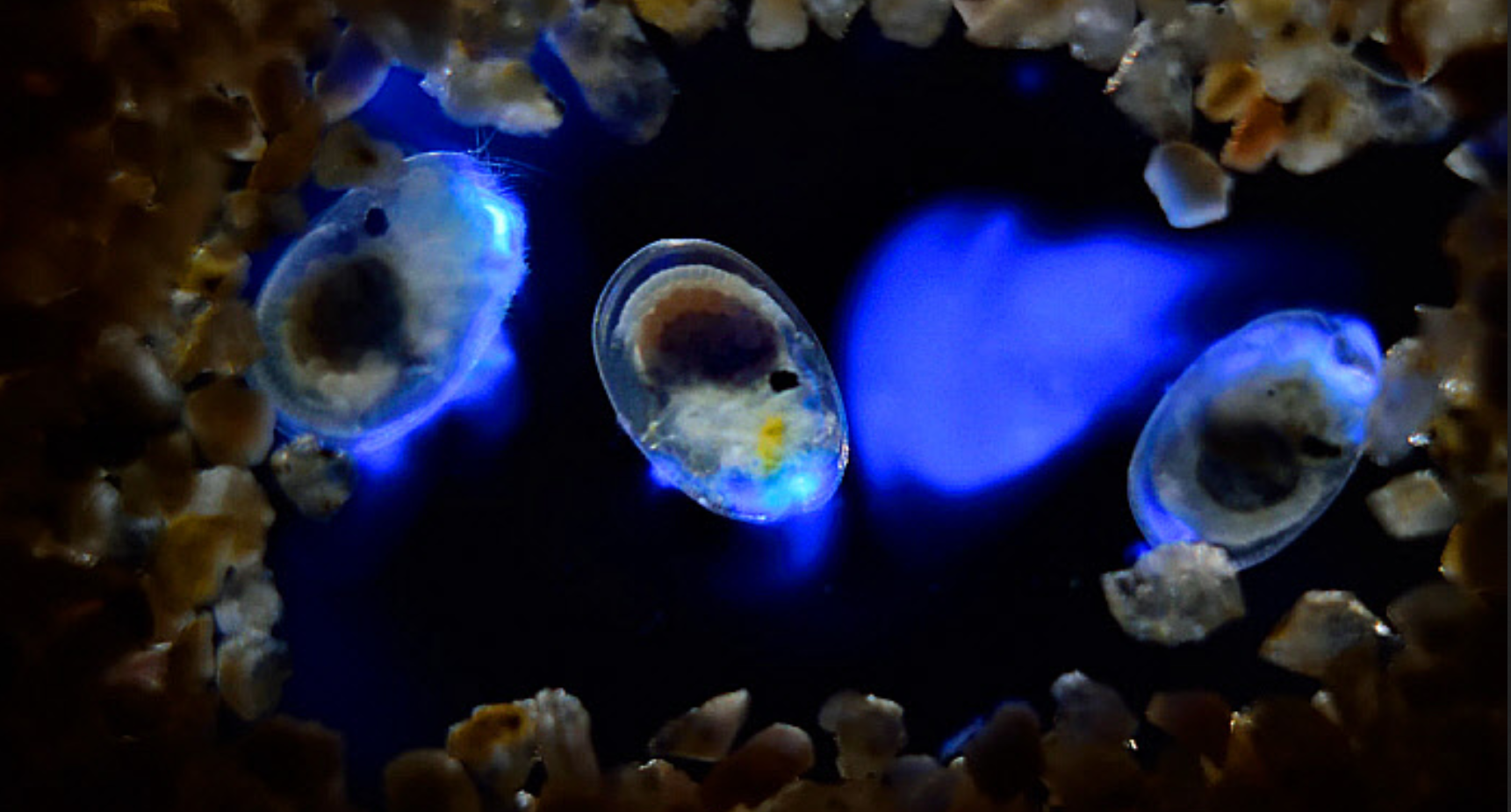
The ocean is full of strange and beautiful creatures, but few are as captivating as the sea firefly. Known scientifically as Vargula hilgendorfii, this tiny marine organism has the remarkable ability to produce natural light. Its soft blue glow has fascinated scientists, photographers and nature lovers for decades. Although it is small enough to fit on a fingertip, the sea firefly has an impressive biological system that allows it to shine underwater.
What Is a Sea Firefly
The sea firefly is a type of ostracod, a small crustacean commonly found in shallow coastal waters. It looks like a small seed or a tiny pearl because of its hard outer shell. Most of the time, the sea firefly lives hidden under sand or among seaweed. Despite its small size that typically measures only around three millimeters, it plays a unique role in its ecosystem. When disturbed or threatened, it releases a glowing chemical substance that lights up the surrounding water.
How Sea Fireflies Produce Light
The light produced by sea fireflies comes from a natural chemical reaction called bioluminescence. Inside their bodies, they store a compound known as luciferin. When luciferin interacts with oxygen and a special enzyme called luciferase, the reaction creates a bright blue light. The sea firefly can control when and how much light it produces, which helps it survive in the wild.
Bioluminescence in sea fireflies is known for being especially vivid and long lasting. This makes them different from many bioluminescent organisms that release short flashes of light. Their chemical reaction is strong enough that it has even been used historically in Japan as a natural glowing ink for night fishing and military communication.
Why Sea Fireflies Glow
The glowing ability of the sea firefly has several important purposes. One of the most important reasons is defense. When a predator gets too close, the sea firefly releases glowing fluid into the water. This creates a bright cloud that distracts the predator and allows the sea firefly to escape into the darkness. The glowing cloud can linger in the water long enough to confuse or blind a predator temporarily.
Bioluminescence can also play a role in communication. Some researchers believe that sea fireflies use light signals to attract mates or coordinate with others of their species. Although the exact details are still being studied, their natural glow is clearly a vital part of their behavior and survival.
Where Sea Fireflies Can Be Found
Sea fireflies are most commonly found in Japan, especially along quiet beaches where the water is calm and clear. One of the most famous locations to observe them is the Seto Inland Sea region. On some summer nights, when conditions are right, the shoreline can appear sprinkled with blue stars as thousands of sea fireflies light up the sand and water. Their glow creates a magical effect that attracts tourists and nature photographers from around the world.
Although they are naturally found in specific coastal areas, their reputation has spread far beyond Japan. Videos and photos of their glowing trails are often shared online, showing just how enchanting this small creature can be.
The Cultural Significance of Sea Fireflies
In Japanese culture, the sea firefly is known as umihotaru. For years, local fishermen admired its bright glow. Before modern lighting technology existed, sea fireflies were collected and used to create a natural source of illumination. Their glowing fluid was sometimes used by soldiers during wartime to read maps softly in the dark.
Today, sea fireflies are more appreciated for their beauty and scientific importance. They are often featured in documentaries and educational programs that explore life in the ocean. Their ability to produce light naturally continues to inspire research in chemistry, marine biology and even technology.
Conservation and Environmental Importance
Sea fireflies are sensitive to pollution and changes in the environment. Their habitats can be affected by coastal development, water contamination and climate changes that alter ocean temperatures. Because they are delicate creatures, their presence in an area can indicate that the water quality is healthy.
Scientists study sea fireflies not only for their unique bioluminescence but also for what they can reveal about the condition of marine ecosystems. Protecting their habitats ensures that this incredible natural light will continue to shine for future generations.
Why Sea Fireflies Matter Today
The sea firefly may be small, but its glowing ability captures our imagination and reminds us of the wonders hidden beneath the ocean surface. As technology and science continue to advance, researchers hope to learn more about how bioluminescence works and how it might be applied to fields such as medicine, environmental monitoring and sustainable lighting.
The sea firefly shows that even the smallest creatures can have a powerful impact. Its light is both a defense mechanism and a symbol of the beauty that exists in nature. For many people, seeing the blue glow of sea fireflies along a quiet beach is an unforgettable experience.
