



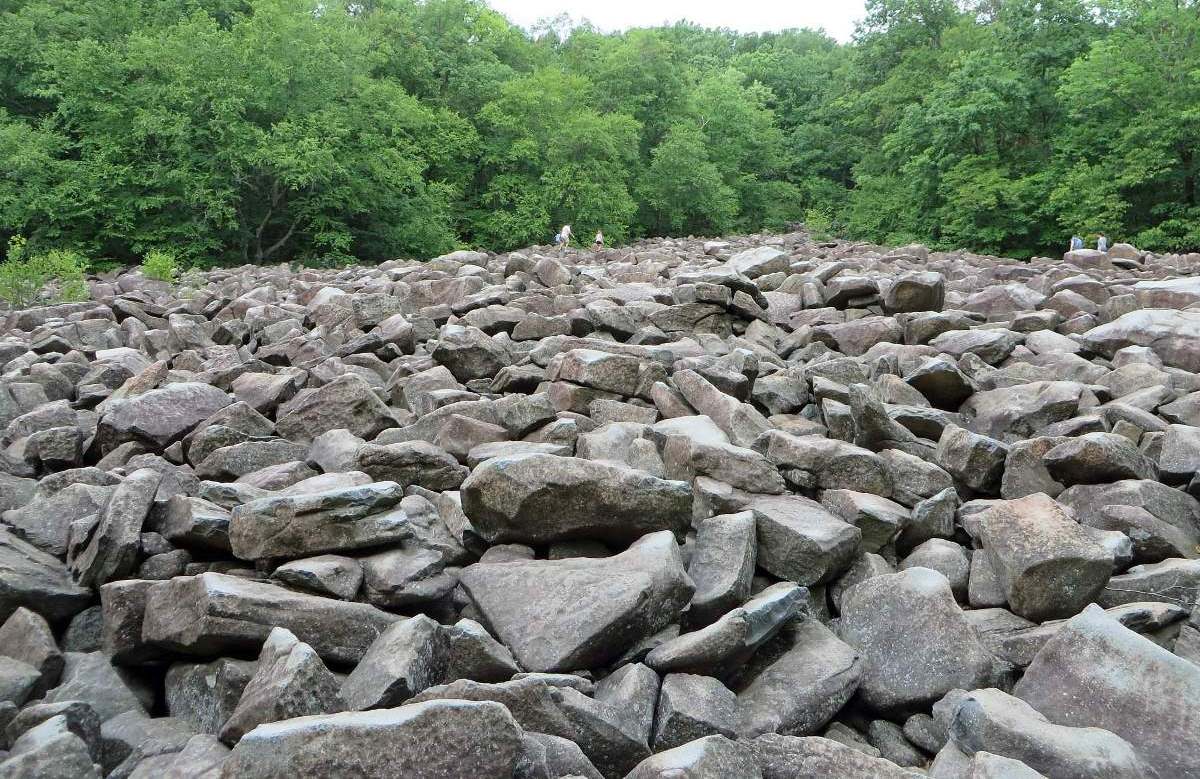
Deep in certain boulder fields around the world, rocks produce deep, resonant tones when struck – often sounding like drums, bells, or gongs. These “ringing rocks” (also called sonorous or lithophonic rocks) vibrate at low frequencies, creating booming, drum-like thuds or metallic rings that echo through the landscape. One of the most famous sites is Ringing Rocks Park in Pennsylvania, USA, where an entire field of boulders on a hillside turns into a natural percussion orchestra.
How Do Rocks Resonate Like Drums?
The secret lies in the rocks’ composition and internal structure:
- Material matters: Ringing rocks are usually iron-rich diabase (basalt-like) or other dense, homogeneous igneous rocks with few cracks.
- Sub-audible vibrations: When struck with a hammer, the rocks produce low-frequency tones below human hearing range. These interact to create audible sounds – deep booms, dull thuds, or clear rings.
- Internal stress: Residual tension from cooling lava millions of years ago acts like a taut drum skin or guitar string. Weathered or fractured rocks lose this stress and only thud dully.
Visitors bring hammers to “play” the boulders, composing eerie melodies or rhythmic drum beats across the field.
Famous Ringing Rock Sites Around the World
- Ringing Rocks Park, Bucks County, Pennsylvania: The largest and most accessible – a 128-acre boulder field with no vegetation, where rocks ring like bells or deep drums. No one knows exactly why only some boulders ring while others don’t.
- Ringing Rocks Pluton, Montana: Massive boulders that produce metallic, drum-like resonances when hit.
- Musical Stones of Skiddaw, England: Used to create actual lithophones (rock instruments).
- Bell Rock Range, Western Australia: Similar sonorous rocks in remote outback.
Why Low Frequencies and Drum-Like Sounds?
The deep, booming quality comes from the rocks’ size and density:
- Larger boulders produce lower pitches, mimicking bass drums.
- The resonance can last several seconds, like a kettle drum roll.
- In fields, striking multiple rocks creates polyphonic “drum ensembles.”
Interestingly, removing a rock from the field often stops the ringing – the surrounding boulders somehow enhance the vibration.
Other Natural “Drumming” Phenomena
While not exactly mountains, related wonders include:
- Singing sand dunes: Avalanching sand creates low-frequency booms (95-105 Hz) like distant drums.
- Booming caves or cliffs: Wind and waves cause resonant thuds.
Ringing rocks remind us that Earth itself can be a musical instrument – a mountain-sized drum waiting for the right strike to reveal its hidden symphony.
