




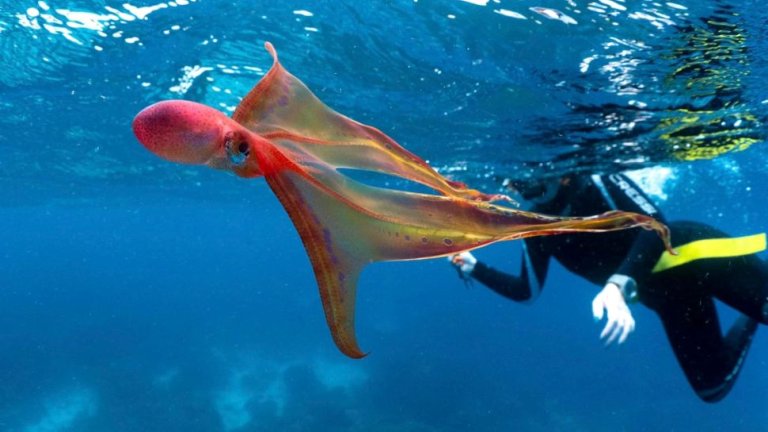
The blanket octopus is one of the most mysterious and visually striking creatures in the ocean. Famous for its flowing, cape like webbing and dramatic appearance, this rare cephalopod is also known for an unusual behavior that surprises many marine enthusiasts. Instead of swimming constantly, the blanket octopus can move along the seafloor in a way that looks remarkably like walking. This unique adaptation makes it one of the most intriguing animals in the marine world.
What Is a Blanket Octopus
The blanket octopus belongs to the genus Tremoctopus and is found in warm and tropical oceans around the world. It gets its name from the large sheets of webbing that extend between its arms, creating a blanket like shape when spread out in the water.
One of the most unusual traits of the blanket octopus is the extreme difference in size between males and females. Females can grow up to two meters long, while males are tiny in comparison, often only a few centimeters. Despite their delicate appearance, blanket octopuses are powerful and highly specialized predators.
How the Blanket Octopus Walks on the Seafloor
Although octopuses are known for swimming and crawling, the blanket octopus has been observed moving along the ocean floor using a coordinated arm motion that resembles walking. By placing several arms on the seafloor and pushing forward, it can glide and step across the substrate with controlled movements.
This walking behavior helps the blanket octopus conserve energy, especially when exploring the seafloor for food. It also allows better camouflage, as slow movement reduces attention from predators. The ability to alternate between swimming and walking gives this species a major survival advantage.
Unique Defense Mechanisms
The blanket octopus is famous for its dramatic defense strategy. When threatened, the female can spread her colorful webbing wide, instantly appearing much larger and more intimidating. This sudden display can scare away predators that might otherwise attack.
Even more impressive is its use of venom. Blanket octopuses are immune to the venom of the Portuguese man o war. They can tear off tentacles from this dangerous jellyfish and use them as weapons, holding them in their arms for protection and hunting.
Habitat and Distribution
Blanket octopuses are usually found in open ocean environments but are sometimes seen near the surface or close to the seafloor. They prefer warm waters and are commonly reported in the Pacific, Indian, and Atlantic Oceans.
Sightings are rare because they spend much of their lives in deep or open water. When they do appear near the surface or coastline, they often attract attention due to their unusual shape and vivid colors.
Diet and Hunting Behavior
The blanket octopus feeds on small fish, crustaceans, and planktonic organisms. It uses its intelligence and agility to capture prey, often relying on surprise rather than speed. When hunting near the seafloor, walking movements allow it to approach prey quietly and efficiently.
The use of stolen venomous tentacles adds another layer to its hunting strategy, making it one of the most resourceful predators among cephalopods.
Intelligence and Adaptability
Like other octopus species, the blanket octopus is highly intelligent. It can solve problems, adapt quickly to new situations, and use tools for defense. Its ability to walk, swim, display dramatic visual signals, and wield venom shows a high level of behavioral complexity.
These traits make the blanket octopus an important subject for scientific research into animal intelligence and adaptation in marine environments.
Why the Blanket Octopus Is So Special
The combination of walking behavior, extreme size difference between sexes, dramatic visual defenses, and venom resistance makes the blanket octopus truly unique. Very few marine animals show such a wide range of survival strategies in a single species.
Its ability to move across the seafloor like a walking creature challenges the common image of octopuses as purely swimming animals.
The blanket octopus is one of the ocean’s most extraordinary creatures. With its ability to walk along the seafloor, display flowing blanket like arms, and use venomous tentacles as weapons, it stands apart from almost all other marine animals. This rare and beautiful octopus is a powerful reminder of how diverse and surprising life beneath the waves can be.
