

A Village That Challenges Reality
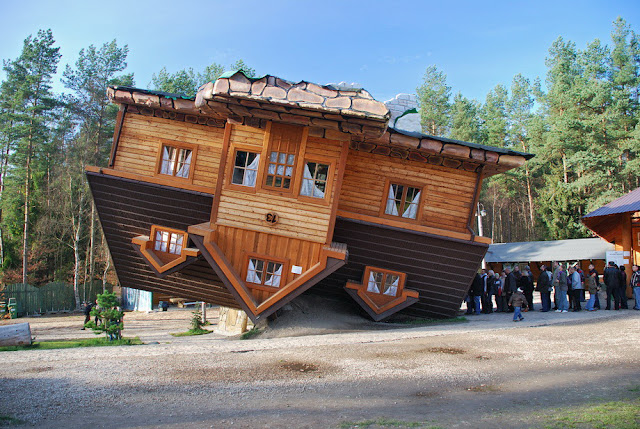
Hidden in northern Poland lies one of Europe’s strangest tourist attractions: the Upside-Down House in Szymbark. At first glance, the wooden cottage looks as if a giant hand flipped it over and left it standing precariously on its roof. Visitors approach the building unsure whether to laugh, take photos, or question their own balance.
The structure has become a symbol of curiosity and creativity, drawing travelers from across the world who want to experience what it feels like to walk inside a house where gravity seems completely confused.
Where Is Szymbark Located
Szymbark is a small village in the Pomeranian region of northern Poland. It is home to the Center for Education and Regional Promotion, an open-air attraction complex that celebrates Polish history, architecture, and culture. Among traditional log houses and historical exhibits stands the most photographed site of all: the upside-down home.
Why Was the House Built Upside Down
The structure was completed in 2007 by local businessman and community leader Daniel Czapiewski. According to guides, the inverted design was meant as a symbolic commentary on political and social confusion during the communist era in Poland.
By turning the building literally on its head, the creators wanted visitors to reflect on how disorienting that period felt for many citizens. Over time, however, the house has become more playful than political, loved primarily for its novelty and surreal atmosphere.
What It Is Like Inside
Walking into the Upside-Down House is far stranger than looking at it from outside.
Furniture on the Ceiling
Inside, everything you would normally find on the floor is attached overhead. Chairs, tables, wardrobes, lamps, and even a television appear to hang above your head. The floor slopes slightly, adding to the dizzying sensation.
A Test of Balance
Many visitors report mild vertigo within seconds of entering. Because your eyes see an upside-down world while your body remains upright, your brain struggles to adjust. The experience is short but memorable, and most people leave laughing or shaking their heads in disbelief.
Architecture and Construction
Building the house required careful engineering. The wooden structure rests on reinforced beams that keep it safely balanced on its roof. Designers had to consider visitor flow, weight distribution, and stability while still preserving the illusion that the house had simply fallen from the sky.
Every detail, from kitchen utensils to picture frames, was secured so it would not move despite appearing to defy gravity.
Why It Became a Tourist Sensation
Several factors helped the Upside-Down House achieve global fame.
- Visual shock value that works perfectly for photography
- Family-friendly attraction suitable for all ages
- Social media appeal, with countless viral images and videos
- Unique storytelling, combining symbolism and fun
Travelers often include Szymbark as a short stop on broader trips through northern Poland.
Tips for Visiting
- Go early in the day to avoid long queues.
- Wear comfortable shoes because the tilted floor can strain your legs.
- Bring a camera or phone with wide-angle capability, as photos inside are especially dramatic.
- Combine the visit with other exhibits in the cultural complex.
A Place That Turns Perspective Upside Down
Szymbark’s Upside-Down House is more than a quirky building. It is a playful reminder that architecture can challenge perception and spark imagination. Whether you visit for its symbolic history or simply to take surreal photos, the attraction delivers a truly unforgettable experience.
